Review: The Traitor Baru Cormorant (Tor, 2015) by Seth Dickinson [also known as The Traitor]


Traitor Baru Cormorant


Review: The Traitor Baru Cormorant (Tor, 2015) by Seth Dickinson [also known as The Traitor]


Short Review:

Bold, challenging, brutal, and demonstrates the author’s total commitment to telling an amazing story. It might have an accountant as a protagonist, but this is first rate fantasy.  Few debut novels are as hard hitting and brilliant.  One of the best novels of 2015.


Longer Review:

Before I get started on this review I just wanted to say that you should read this book.  Seriously.  Just read it.  Stick with it from beginning to end.  Then, once you are done, take those few moments of quiet and think about what you just read.  This is a stunning novel, brutal and beautiful in equal measure.  Smart, intelligent and powerful.  Thought provoking and entertaining.  This will become known as one of the classics of fantasy literature, a feat made even more impressive because it is a début.  So, read it all the way through to the end.  Although, fair warning, you will probably love it and hate it in equal measure, but hate it in the way that means you were enthralled by it and it has gotten under your skin.  Love it because it is unexpected, unconventional, and has an emotional resonance that goes to your very core.  This isn’t a cosy fireside fantasy. This isn’t an easy ride of heroic quests.  This is the type of fantasy that challenges you, changes you, and leaves you wrecked, shivering, and wanting more.

  Continue reading

Teaching Genre Fantasy : One Approach

dm_disaster

What I am going to discuss today is my experience with and attempts to construct a 12 week undergraduate syllabus for the study of Genre Fantasy Literature.

So a couple of very quick disclaimers:

  1. This is not prescriptive; this is a starting point for discussion.
  2. This is based on my experience of teaching in the UK therefore it is a 12 week block comprised of four hours contact time each week, with a ‘reading week’ or ‘independent study week’ occurring in the second half of the semester.
  3. The four hours are divided between a 1 hour lecture, a 1 hour workshop in which the lecture is discussed and questions answered, and a 2 hour seminar discussion group in which the reading for the week is discussed in relation to the lecture and topic.
  4. In the UK system we favour essays over class tests so the examination criteria reflect this.
  5. The focus is on Genre Fantasy literature, not fantastic literature in general, SF, horror, genres of fantasy, speculative fiction. Therefore this is a pretty specific remit that does not take into account mythology, folklore, faerie tale, the Gothic, Weird Fiction, Science Fiction, Space Opera, the Fantastic, Fantastik, Fantastique, and so on.  So there are a great many texts that have been excluded or that don’t fall under the rubric for the class.
  6. As with so many subject syllabi, this was an exercise in practical and pragmatic selection, so a number of texts were chosen for their expediency rather than their status or critical appreciation.
  7. The class is aimed at English Literature Students, it would be an elective module, and would be second or third year undergraduates.
  8. The module follows a thematic overview of Genre Fantasy rather than an historical perspective of the genre, although elements of genre history will obviously be discussed.
  9. Each of the three mini-sections utilises a single key primary text, in addition to excerpts from additional texts, short stories and critical works.
  10. Lastly, the focus of this class was to teach critical awareness of Genre Fantasy, Genre Theory, Literary Theory and to develop skills in textual analysis, and as a result texts were chosen that aided the teaching of the subject and that fitted in with the approach that I wanted to take.

So this is not a typical paper presentation.  I thought I would take you through how I designed a Genre Fantasy Syllabus, and at the end we could discuss the pros and cons of approaching teaching this way.

Continue reading

Review: Orcs: First Blood by Stan Nicholls

Orcs Stan Nicholls

The Orcs Omnibus is the complete collection of the Orcs: First Blood trilogy by Stan Nicholls.

I was initially intrigued by the idea of a book written about and from the Orcish perspective. They are after all the much maligned evil cannon fodder of many a genre fantasy and it would be interesting to read a story from their point of view.

Unfortunately this is where I ran into the first let down of this series. The Orcs of this book don’t read like ‘real’ Orcs. Ok, Ok so no Orcs are actually real, but Nicholl’s Orcs are effectively ‘noble savages’, that is pretty typical fantasy barbarians who happen to have lightly green and clammy skin, brutish looking faces, and a propensity for physical violence. Unfortunately if you took out the visuals they would resemble half a dozen other barbarian races that inhabit fantasyland. There are occasional flashes of humour, especially when the Orcs joke about living up to their stereotypes (most notably early on in the opening sequence when they joke about eating a human baby… doesn’t sound funny when it is put like that but it is worth a short chuckle when you read it in context.) but ultimately there is little about them that distinguished Orcs from any other race. So rather than this being a book that redresses the balance and gives you the Orcish perspective, it is just one more quest trilogy about misunderstood noble/honourable barbarians.

Continue reading

Illustrating a Dream: An analysis of the art of storytelling in Gaiman and Vess’s ‘A Midsummer Night’s Dream’

Dream Country

This paper is a brief look at some aspects of The Sandman, in particular issue 19 “A Midsummer Night’s Dream”[1].  For any here who don’t know about The Sandman, it was a series of monthly comic books which ran from Dec ‘88 until the last issue in March ‘96.  However most of us will be more familiar with their current incarnation as a series of 10 graphic novels.  Published by DC Comics, under their Vertigo label, these groundbreaking comics have received critical acclaim, cult following as well as some degree of literary scrutiny.  While the various issues were all written by Neil Gaiman, a number of different artists were employed to illustrate the stories.  Although the term ‘illustrate’ is problematic as this paper will address.

The purpose of this paper is to examine the comic in terms of the meta-narrative and ideas of multiple and parallel realities and how this achieved through both textual referencing and the use of the art.  In particular how the art itself not only illustrates the text but is an added dimension to the narrative and supplies its own coded information for the reader.  As an additional note I owe a great deal of this paper to Jo Sanders’ article in Extrapolation on a similar topic in relation to this issue.

Continue reading

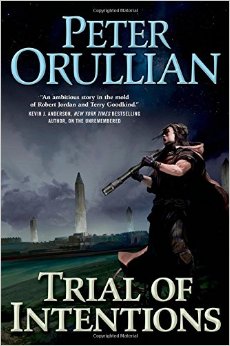
Review: Trial of Intentions (Vault of Heaven Book 2) by Peter Orullian

Trial of Intentions


Short Version:

An epic fantasy that plays with genre tropes, but not always in the way you expect.  Fantastic worldbuilding that includes a fascinating magic system that permeates the world and its sciences, interesting plot choices that cater to but nor are beholden to classic fantasy storytelling, and a Book 2 that can act as a book 1 for new readers.  It is a massive improvement from The Unremembered.  A book to read.


Longer Review:

When I am wrong, I am happy to admit it.  Ok, so happy is probably the wrong word.  Grudgingly.  Yes, when I am wrong, I grudgingly admit it.  I went into reading this book with some trepidation.  The first book, The Unremembered, contained hints of a greater story, intimations of fantastic ideas, and it suggested that the author had the best of intentions with the story he was telling.  But, as my earlier review of it suggests, I was less than impressed with the execution, in fact I was pretty damning.  However, those hints of depth, the small elements of creativity, and the chance that some of those things could come to fruition made me try the second book.  When I started reading Trial of Intentions my first thought was ‘Is this the same author of The Unremembered?’  The setting was the same, the characters had the same names, and the threats in the world were the same… but the writing was better, the character development was better, the focus of the story was better, the plot was more interesting, the world was more sharply realised, and it no longer seemed stereotypical or trite.  So, let me (grudgingly) say that I was wrong.  This is a book worth reading.  This is a series worth reading.  And Peter Orullian is an author worth paying attention to.


Trial of Intentions begins shortly after the climactic events at the end of The Unremembered, so the characters are in the midst of processing what exactly has happened to them, what it means for the world, and wondering where they go from here.  Given the severity of the confrontation at the end of Unremembered there are devastating ramifications for each of the characters.  They have been changed, but don’t yet understand how and this is very good for the story.  This functions as an initial re-introduction of Tahn, Mira, Sutter, Wendra, Vendanj, and Braethan that very briefly recaps what has happened to them and highlights just how their characters have been altered by events and begins to address what this means for them as well as suggesting avenues for character development.  But before it descends into tedious character introspection and exposition it is nipped in the bud at the best moment and action descends in the form of a fairly epic battle.  But make no mistake, Orullian never forgets about the character elements, he now just works them into the action and story so the reader can see their characters develop and not simply be told that the characters have developed.  Oddly enough, this habit of alluding to previous events while actively engaged in new ones, adds depth to the story and a sense of history to the narrative and it is something that Orullian never loses sight of.  This results in Trials actually functioning as an entry point into the series and renders The Unremembered as slightly superfluous.  But the upshot is that we are presented with characters who are now much more interestingly constructed, who are trying to work through complex and powerful emotions, who are active participants in the grand narrative, as well as their own personal stories, and who have no time for navel gazing as the fate of the world is at stake and the barbarians are at the gate.

Speaking of the barbarians.  One of my great dissatisfactions with Tolkien’s classic The Lord of the Rings is the lack of voice given to the Orcs.  The brief glimpses we have of their culture, lives, and perspective, are vastly overshadowed by the power of the heroic narrative.  They are generally just brutal, monstrous enemies that are irredeemably evil and need to be destroyed without compunction or pity.  Orullian directly challenges this stereotypical position of demonising the enemy into a monstrous voiceless other and gives a series of POV chapters to one of the residents behind the Vale in the land of the Quiet.  Kett, the Inveterae, is a member of one of the many races that are imprisoned in the Bourne.  The short chapters dealing with his story add a great deal of depth and complexity to the conflict and emphasise the ‘two sides to every story’ adage.  While this is just one POV among many, it is refreshing to see that the world of ‘the enemy’ is as complex and as contradictory as that of the ‘allies’.  The introduction of Kett and the world behind the Vale also gives the story more balance in terms of what is coming and is a very welcome addition to the story.  The threat of invasion is that much more real and powerful because the reader witnesses the preparations and begins to get some insight into what motivates the Quiet.  Without this the enemy would remain a shambling horde of monsters and vague threat who, despite the effort Orullian has made to ensure they are distinct from Orcs and Trolls, would just be standard fantasy hero-fodder.

Of my many complaints about the first novel, it appears that Orullian has already anticipated them because most of my questions and areas of criticism have been roundly and solidly addressed in this story.  Where Unremembered was solely focused on Tahn’s quest, blindly followed Vendanj around on an extremely linear travelogue, and had the hero-centric narrative that has become stereotypical in the genre, this volume has a truly ensemble cast and presents a variety of story type.  Each of the characters now feels a great deal more rounded and has their own motivations for their actions, as well as exhibiting more complex emotions.  But more than that, the characters now feel active instead of passive.  They are executing plans.  They are attempting multiple approaches to solving the problem.  They are engaging in their own stories.  And each of those stories, while part of the greater narrative, is relevant, interesting, and distinct.

The orders of the Sheason and the Sodalists are finally explored and explained and Orullian works these facets of the story into the broader narrative so that they don’t feel like asides or expositionary lumps.  The events and crises in both the orders, especially the investigation of the Sheason order, from various perspectives, is one of the real pleasures of the book.  In particular, the view of Thaelon, as both the leader of the Sheason and the more private view of him as a father, is genuinely engaging and interesting.  Seeing his relationship with his daughter, and with the various other Sheason, adds depth and definition to both him and the order, making the entire concept and organisation that much more believable.  Seeing the schism within their ranks and how it affects him as well as the others gains a great deal more potency and emotional resonance as a result of this.  In terms of the wider story being told, the decisions made, with the best of intentions [pun intended], end up having severe ramifications for the conflict to come, as well as provide engaging exposition for the magic system and raising interesting questions about morality and order.

As with the rest of the book, the events actually affect the characters deeply instead of the characters merely paying lip-service to what has happened and carrying on as the narrative dictates.  Orullian presents characters being shaped and changed by what they see and experience and this makes them more rounded, understandable and relatable.  Due to their flaws, their decisions, good and bad, they come across as ordinary people trying to do their best in the most desperate of circumstances.  In other words, we can believe in them as people, not just characters or narrative functions.  This also results in both the micro- and macro-level of storytelling feeling more real, feeling more authentic, and giving the narrative a cohesive weight.

The conflict within the Sheason order is actually directly related to the events in Recityv and the politics of the city and the political storyline really comes alive in this volume and forms the major thrust of the book.  Set in Recityv and focused on the Convocation of nations, it blends the political manoeuvrings of the city from the perspectives of both Roth and Helaina with the stories and perspectives of the Sheason Vendanj, the Sodalist Braethan, the exile Grant, and even finds purchase in the magical, musical training storyline of Wendra in the Descant Cathedral.  Of all the plot threads that run through the story, this was the one that both captured my interest as well as slightly frustrated me.

On the positive side, Orullian demonstrates some great character writing.  Roth, the primary antagonist of this volume is a real piece of work.  He is despicable, arrogant, self-serving, ambitious, fervent, and fanatical, and yet, Orullian gives the reader insight into what actually motivates this man.  Roth could easily have become a caricature of an overly-melodramatic villain with moustache twirling plans, but what makes him truly fascinating and horrifying is his steadfast conviction that he is in the right.  Even more worrying is that some of his arguments and reasons sound eminently reasonable.  He is no frothing at the mouth mad-man, but a calculating and passionate advocate for a particular world view.  Orullian managed to create a character compelling enough to hold my interest, fascinate me, and, at the same time, make me want to stab him… in the face… with a saw-blade… repeatedly… So as a villain he is compelling, has depth and understandable motivation, and wants to save the world from what he sees are its faults.  The fact that those are the very things actually protecting the world puts him clearly in the villain camp, but we can understand why he acts the way he does.  Like Kevin Spacey’s character in House of Cards (2013-) he is someone whom you love to hate, but whom you can almost admire.

Helaina, on the other side of the political conflict, is also another character who grows leaps and bounds in this story.  She is very much the mirror of Roth.  He came from the streets, she was a child in a wealthy merchant family.  He is a fanatic who will sacrifice anyone to achieve his ends, she is a moderate who wants to work with people to bring them around to her way of thinking.  Yet both want what they see as best for the people, they are both willing to do what is necessary, even if it isn’t the most popular decision, and they are both convinced that their way is the right way.  Just like Roth, she has a vision for a better world.  Unfortunately for her, Roth’s vision and her own are entirely incompatible and are mutually exclusive.  Because of the constant opposition from the League of Civility she is struggling to hold the city, the land, and the world together in the face of an impending invasion from magical creatures and is in danger of losing everything to Roth before the Quiet even invade.  Her allies, the Sheason and the Descant, are directly threatened by the League.  Potential political allies are being manipulated or threatened.  She is beset on all sides yet displays enormous strength of will under the trying circumstances.

The back and forth between Roth and Helaina is fantastic to read, but… and there is an unfortunate but here… but, Orullian seems far too fond of Roth and lets the narrative become a little too contrived in order to keep Roth alive and important as an antagonist.  No matter what he does, no matter how despicable the act, and no matter how many times characters come into direct confrontation with Roth, no one ever seizes the opportunity to kill him.  He is built up to be the sole voice of the Civilisation movement, and not once do any of the heroes really try to take him out.  All of the conflicts result in Roth walking away, only to reappear about a chapter later and do the same things again.  Not only that, but he appears in almost every single League plan and important scene.  For the leader of a huge organisation that spans countries, he doesn’t seem capable of delegating at all well.  At times, despite being told how large the League is, you get a sense it is just Roth, a few friends, and a random collection of nameless foot-soldiers.  It also becomes a trifle frustrating that he can clearly engage in treachery, treason, murder, arson, blackmail and a host of other offences, but that even in the midst of chaotic insurrection the heroes fail to kill him.  It ends up feeling a little too neat.  A little too artificial and forced.  This is truly unfortunate given the strong elements of authenticity that Orullian has worked into the rest of the story and the world.  But it should be said that the vast majority of the Recityv storylines are fascinating and compelling reading.

Also in Recityv is Wendra’s story, mostly located in the Descant Cathedral.  While the Sheason practice a form of magic called rendering the will, Wendra is a Leiholan, a person with the ability to create magical effects with her singing.  While magical music is not exactly new, Orullian gives it passion, power and persuasiveness through his prose.  A guiding concept of resonance flows through the book and magic system, and goes to the core of the interpersonal relationships in the novel, and the fact that we are all shaped by our encounters with other people.  Wendra’s raw song, shaped by pain, betrayal and loss, is evocatively rendered on the page and like her character, it evolves and changes over the course of the story.  Once again, Orullian gives his characters the ability to be shaped by their experiences and we see this clearly in Wendra’s decisions, which might be right for her, but not necessarily right for the rest of the world.  Wendra is no longer the captive in need of rescue, and she is increasingly the commanding figure at the centre of the story.

Her interactions with Belamae, the Maesteri of the Descant, and her lessons in magic and music theory are a welcome change of pace and tone from the political storyline, and give the reader a more comprehensive understanding of what is at stake here, as well as how the magic actually works.  While Belamae is something of the kind, avuncular mentor, commonly found in fantasy, even he has a past and has made mistakes which round out his character and make him more than the magical maestro Dumbledore to Wendra’s Potter.  What is also nice to see is that despite the fact that Wendra has this incredible magical talent, she still needs lessons and practice in order to use it.  Mozart may have been a musical prodigy, but he still needed to learn how to read and write sheet music.  Wendra demonstrates time and again over the course of the story that she has raw power, but like the Sheason storyline and the themes of the political plot, her story asks questions about how, why, and when power should be wielded.  It asks the reader to consider the interaction of personal judgement, societal benefit, concepts of right and wrong.  It asks about intentions.  Orullian isn’t afraid to show his characters making mistakes, or to show heroes doing something morally questionable, just as he isn’t afraid of showing us the ramifications of this, the personal and wider cost, but he also ensures that all these aspects resonate and echo with one another.  There is a underlying tone and theme to the entire novel and this complexity and depth adds a significant richness to the entire endeavour.

Sutter and Mira probably have the least imaginative storyline presented, and one that feels more like a minor thread to the main political story.  In effect it is a fantasy travelogue to secure allies that visits two locales that may seem a bit familiar to fantasy fans.  The peaceful, hidden garden-like home of the Laeodalin (who are definitely not Elves because they don’t have pointy ears) and Ir-Caul, the home of the Smith King (who is definitely not a Dwarven king obsessed with being a blacksmith because he is tall).  But even here Orullian ensures that there are personal motivations and ramifications for their actions, and gives their scenes a sense of intimacy and truth.  Mira and Sutter have a chance to start to develop on their own, away from the burden of Tahn’s storyline, and away from the more commanding presence of Vendanj.  Of the two, Sutter gets more time to develop as a character while Mira still has things happen to her.  On a minor note, I found the incidents in Ir-Caul to be a little straining of incredulity and smacking of narrative convenience.  Some of that is expected in fantasy writing, and to be honest, occurs in lots of other books, fantasy or otherwise.  I am not going to castigate an author for the same sin that so many others are equally, if not more, guilty of, but it was still a little annoying that the entire conspiracy unravelling hinged on happenstance, incredible strokes of luck, unlooked for information from random characters, and a slightly trite romance story.  But, it was still an engaging story and it kept me reading.

The last major plot thread belongs to Tahn himself.  On the one hand I admire Orullian’s choice to place Tahn on a quest not to defeat evil, nor find a weapon to destroy the invading army, but to find a way to stop the war from even starting.  So rather than trying to defeat the enemy, Tahn seeks a way to stop them becoming an enemy.  I also admire that this ‘quest’ occurs in Aubade Grove, the fantasy equivalent of MIT and Harvard.  That’s right ladies and gents, Tahn goes to university to essentially research and give a PhD defence to a bunch of academics who may or may not have been infiltrated by agents of the Quiet.  It is a bold decision and was very interesting, but, unfortunately I am perhaps a little prejudiced about this storyline because of my background in academia.  This is no fault of Orillian’s, but knowing what academics are like, and understanding the process of a PhD viva made Tahn’s plan of action seem ludicrous in my eyes.  Plus, his new found aptitude for physics, mathematics, astronomy, rhetoric, and philosophy, while explained, just stretched my suspension of disbelief too far.  Despite this, it is an engaging storyline and illustrates just how full and deep the world of the story is.  Orullian links the magic with science and expresses it in a fairly convincing way.

All in all, Trial of Intentions is a great book.  It has everything that fans of fantasy clamour for, and some things they didn’t know they wanted.  If you like epic fantasy, or quest fantasy, if you like fallible heroes and interesting villains, then this book is worth a read.  I know that I will be anxiously awaiting the next book.


Review: The Unremembered (Author’s Definitive Edition) by Peter Orullian


The Unremembered


Review: The Unremembered (Author’s Definitive Edition) by Peter Orullian
Book One of The Vault of Heaven Trilogy


[Edit Note: Having just read the second book I am really glad I stuck with this series.  So while the review below is fairly negative, Book 2 Trial of Intentions is by far the better book, and the promise in this series finds fruit in the second volume.]


Short Version:  A solid epic fantasy that hits all the right notes, but perhaps in a slightly too familiar tune.  It might not blow you away, but it does promise a much deeper and rewarding story in subsequent volumes now that the foundations have been laid and the author feels freer to explore the world he has built.


Longer Review:  The publishing history of Peter Orullian’s first volume of the Vault of Heaven trilogy is a fascinating story in and of itself, one that resulted in a new version of the first book being released that is significantly shorter and quite different from the original release.  As this is the author’s preferred edition, the latest edition, and the one that now serves as the first book of a trilogy, the review below is of it and not the original publication.


Fans and authors walk a tightrope when it comes to epic fantasy.  As fans we want more of the same, only different.  Like the Lord of the Rings, only different.  Like The Shannara Chronicles, only altered.  Like the Wheel of Time, but new.  Familiar enough that they feed the same appetite, but different enough that they don’t feel like carbon copies.  But we also complain loudly when authors aren’t original enough, aren’t innovative enough, and conversely, when they are too innovative, too original.  Authors want to produce recognisable fantasy epics but ones that are unique.  They want their stories to cater to the tastes of the fans, but serve them something they haven’t had before.  There are formulas, tropes, conventions (not the comic-con kind), and stereotypes, and an uneasy, tacit agreement that some should be used, others subverted, and that, in the end, the whole should be a new dish made out of familiar ingredients.  I say all this, because in almost every fantasy epic there are recognisable and familiar aspects.  Those that deviate too far from the beaten path often lose the reader.  Those that stay beholden to established patterns become predictable and not particularly entertaining.  What complicates this further is when the story being told in a volume is a book one, a first step into a new world, the opening of a narrative that is to be at least three volumes long.  Judging a play by its opening act can be a mistake.  Judging a mystery novel by its opening chapters robs the reader of the conclusion.  But in those instances, the whole is present there in one sitting.  For fantasy trilogies, the whole story, spanning three volumes might be thousands of pages long.


So what has this to do with Orullian’s The Unremembered?  Quite a lot it turns out.


I don’t set a lot of stock in plot summaries because, by their very nature, they distil the story down into a few lines bereft of context, flavour or character, and are bland generalisations of what you find in a book.  But they do give you an idea, however vague, of what you are about to read.  So, with my provisos in place that this is not truly representative of what is actually delivered in the book…


A brief summary of the plot will have fantasy fans groaning as it appears as stereotypical and unoriginal as you can get.  A young boy with a special magical gift (in this case with a bow), on a journey with a magical and wise man, accompanied by a close friend to provide occasional comic relief, a warrior woman, a sister with a magical ability with song, and an apprentice warrior scholar.  Ok so the last one might look a little out of place.  They are on a quest to journey to a mystical place in an effort to save the world from a mystical evil.  A dread magical evil that had previously been banished from the land, but the barrier holding the evil back is failing.


So on the face of it there is little here to suggest that Orullian’s book is anything but ‘unremembered’, as off-hand I can think of several series that have very similar plots and remember them quite well.  The over-arching story of The Unremembered is very familiar and well-trodden.  Although it should be pointed out that it is well rendered, well told and interesting, but the story itself seems like the foundation work for a bigger story, a larger story, and, at the end of the day, a much more interesting story.  As I read I kept waiting for the world to drop away as some amazing plot development sprang into the fore, but that never materialised.  There are hints of this grander narrative, the tantalising glimpses of a rich history that will be developed in the future, flashes of plot points that look dead set to blossom into a rich, deeper and more original tale in future instalments, but as it stands, The Unremembered is a solid foundational epic fantasy that does all the plodding groundwork of laying out the bones with none of the real pizazz as it relentlessly pushes the characters through the plot.


But well drawn characters can make even the most well established stories come to life.  Yet, unfortunately, once again, while the groundwork appears to have been laid for all the characters to become much more interesting in the next book, this volume fails to give them the necessary moments to shine and stand out.


Tahn (a name that autocorrect loves to change to Than) is the typical, slightly naïve youth with a mysterious past, mysterious power, and mysterious destiny.  All very mysterious.  As the central protagonist there are strong shades of every other young, slightly callow, boy-destined-to-be-great character from fantasy.  But the story ends just as he experiences something that might actually change him into someone much more engaging and unique.  This is not entirely unforeseeable as the story focuses on Tahn’s journey toward the rite of passage that will make him a man.  He is not badly written, he is not overly annoying, he is just not fully developed here.  He is the bare bones of the character he will become, the opening refrain that introduces the symphony.  Adding to this lack of development is the significant effort expended by the other characters, and by the author, to keep Tahn unsullied as a character, to keep him pure and prepare him for the magical judgement.  But, as a result, the muck and grime that gets under the fingernails of great characters is simply missing here.  He never gets the folds and careworn creases that make the character feel real.  There is so much potential to his character that this story never quite gets to, and yet… and yet… there is a strong promise that the story and his character will explode with the next volume.


Vendanj, the Sheason (wizard monk) is almost the typical grumpy wiseman leading the quest group.  He utilises the Will (similar to the Force from Star Wars if I am brutally honest, or The Will and the Word from Eddings’ Belgariad) but he is at least a great deal more pragmatic and dangerous seeming than many of his epic predecessors and peers.  By the end of the story we have been granted glimpses of his interesting backstory and of the wider conflict he is part of, as well as moments of depth and complexity to his character.  But in terms of development, much of his time is spent forwarding the plot to the next stop in the quest journey, pushing focus onto Than as the most important person in the universe,  and being slightly mysterious for the sake of being mysterious.  It is not all bad though, the cost of wielding the Will appears to be pretty high and despite the narratively convenient moments of respite from attack, it appears that future Vendanj may have a significant bill to pay concerning his use of power.  Also his conflict with the political forces of the world as well as the magical ones, and the schism forming in his own religion suggest that Vendanj’s story will grow in originality and complexity.  He has the potential to be a great addition to the pantheon of guiding mentor figures of fantasy as he has feet of clay, and there are hints of more than superficial brusqueness and irritability to his portrayal.  But the reader isn’t given the opportunity to truly experience his unique flaws and we have yet to bear witness to the cost of his actions, all that is yet to come.


Wendra is Tahn’s sister, and by far the most interesting of the assembled quest-party.  Admittedly she has a rape and lost child backstory that grates the teeth a little, and her arc in the book involves her being captured, but she has definite character and strength of will.  She is no damsel in distress, and, while the kidnapping plot is a little stale by this point, Wendra never feels like a helpless victim waiting to be rescued.  Her ability to shape song into magical effects, while still in its infancy in this volume, is one of the high notes of Orullian’s book.  Magical music and singing is hardly original in fantasy stories, but Orullian imbues it with a complex vibrancy that makes it believable and really brings it to life.  To borrow a term from the book, he imbues it with resonance.  One of the major strengths to Orullian’s writing here is his use of this magic system, and affinity with how music is magical and powerful.  While only the first few notes of this system are played out on the page, it does promise to be a fascinating and powerful aspect of future books.  Yet, returning to Wendra, due to the nature of the story focusing on Tahn’s journey, she is given pretty short shrift here, even if the ending once again promises a lot more from Wendra in the books to come.  But all the seeds are there for her to really grow and become a dominating figure of the larger story as her power, will and character rival her personal tragedies and losses.  Of all the characters she seems to have the most potential to be realised, and, given the importance of song to the magic system and to the world, as well as Wendra’s ability, she will undoubtedly have a much more important role in the later books.


Mira, a Far, one of the magical races of the world, is a warrior who will die at the edge of maturity (which seems to be around 18 or 20) like all the members of her semi-magical race.  Blessed with supernatural quickness and apparently no need to sleep, Mira is the warrior protector of the group.  She is knowledgeable about the magical threat the world faces, but isn’t really forthcoming about her mysterious race, the magical backstory, or the strange history of the world despite the fact that it would seem to be useful information for the group.  While she has a number of action scenes her main purpose in the story seems to be to serve as Tahn’s first crush and to dispatch the occasional enemy.  But, as I seem to keep saying for each of these characters, the ending of the book should have significant and far reaching ramifications for Mira that will make her a great deal more interesting and rounded as a character in later volumes, rather than simply acting as an alluring, yet aloof love interest for the hero.


The Sheason Vendanj is aided by the novice Sodalist, Braethen.  If the Sheason are magical warrior monks who fight demons, the Sodalists appear to be learned warrior monks who use swords to fight demons.  Yeah, I am not really sure what the relationship between the two orders is even after reading the book.  But Vendanj uses magic, Braethen uses a sword (albeit a magical one).  Again, despite this being a fairly lengthy book, there never seemed to be time to delve into Braethen’s character.  Sure we are told his backstory a couple of times, but we never get the sense of how this shaped him, how his background made him who he is and helped him choose this path.  In part because we have no context for the choice.  His father was an Author and Braethen disappointed him by becoming a Sodalist, and his major accomplishment in the novel is finding a necessary passage in a book he once read when his father was training him as an Author.  Nope, still don’t get why him being a Sodalist is important or what it even means.  And yet, oh how this is getting repetitive, the strange sword, the mystery of what Sodalists are and his burgeoning partnership with Vendanj promise that he could become a great deal more interesting in book two.


Sutter, Tahn’s best friend from home, comes from humble beginnings, provides occasional comic-relief, but seems more to be there to ground Tahn and be a supportive sounding board for him rather than to be a character in his own right or the hero of his own story.  Once again, a development late in the story leads to Sutter becoming a great deal more interesting, but the investigation of that development seems destined for later instalments.  This feeling of being under-used and unnecessary to this particular part of the story is also true of the young boy, Penit, the stereotypical ‘young rogue’ who was a player in a travelling troupe of actors but whose family were killed.  Penit is necessary for part of Wendra’s story more than anything else, and, despite some nice moments, seems wasted in the novel.  In fact, he becomes more an object than a character as the novel progresses.  In what is now seeming a haunting refrain, the end of the novel does promise interesting developments for Penit in the sequels and his character could suddenly become a lot more interesting and important.


The late addition to the group is Grant, an exiled traitor and former special soldier who takes in abandoned children in a wasteland, training some and placing others with surrogate families.  Of all the characters, Grant feels the most rounded.  His backstory is explored over the course of the story from a couple of different perspectives, adding detail and nuance that is missing from the other characters’ histories.  But, perhaps more importantly, the reader gets to see some of the ramifications of his history, and how it has shaped him and his world view.  He is not the usual stereotype of grizzled veteran that one might expect to see in such a traditional quest group line up, as there seems to be a real sense of identity to his character that is a little lacking in the others.


As to be expected there are a few other characters who come into play and although each could possibly be developed further, the same problem seems to exist with all of them.  In this story they exist as embryonic characters who have not had the chance to fully develop independent of their role in the plot.  They are tools of the narrative, plot functions, story roles given lines.  Much of this is due to Orullian pushing plot and story at the expense of letting the characters live through the experience and trusting the reader to be interested in them and not just the events.  But through it all, his writing demonstrates that he has a strong conception of who these people are and he clearly has plans to reveal more about them and their struggles.


Despite these complaints, there is real promise in this story, and there are definite signs that further instalments will be better.  For a start, the pieces have been laid in this book for political turmoil pitting a powerful, quasi-military order against the main civilian government.  There is a suggestion of lots of political intrigue, manoeuvring, and shenanigans to come as the self-appointed guardians of right, The League of Civility, are brought by this book into almost direct conflict with the Regent of Recityv, the Sheason order, and, of course, our heroes.  Additionally, while the magical menace of this particular volume seems to use pawns in the form of Orc and Ringwraith analogues, revelations at the end promise a greater diversity of foe, and a more complicated rationale for their attempted conquest and destruction of the human lands.  By promising us a war to come on two fronts, one mundane and one magical, Orullian is really raising the stakes and complexity for the later volumes’ story, and therefore, while some of what has occurred in The Unremembered seems well-worn and uninspired it appears that Orullian is using those very aspects as the building blocks for a much greater narrative.


Many of the criticisms I have raised here are a harsh judgement centred around a single, central flaw of the book, and that is an earnest and focused dedication to telling the story rather than showing it.  Despite this, there are many moments when it is clear that Orullian has the talent and ability to deliver something greater than the sum of its parts, and some of his writing really sings.  But, as a whole, The Unremembered is too busy rushing through plot to let the natural story evolve.  If this is taken as the opening act of a play it forms the solid basis for subsequent acts, even if it doesn’t quite deliver on its own.


So You Want To Be A Dragon Slayer? Character Generation in RPGs and Genre Fantasy

dungeons_and_dragons_party_by_uncannyknack-d7j7l0r

So You Want To Be A Dragon Slayer?  Character Generation in RPGs and Genre Fantasy

The relationship between Fantasy literature and Role Playing Games is well known but is often overlooked and at times misunderstood.  Many consider fantasy literature to be the inspiration behind or inspiration of RPGs and overlook the reciprocal nature of this relationship.  I am hoping that this paper will show how the use of RPG conventions and processes can be used as a basic analytical tool when it comes to understanding and analysing fantasy narratives.

So let us begin with a very brief breakdown of my terminology; Genre fantasy, RPGs or roleplaying games and series fantasy.

Genre fantasy is perhaps the most ambiguous of the three, even if it is bandied about frequently, and we all tend to understand it in our own way. In the Encyclopedia of Fantasy Clute and Grant lay out a few guiding terms in order to define this ethereal concept.  The first is that there is a secondary world where magic exists or can exist, for example Tolkien’s Middle Earth, Feist’s Midkemia, and Brooks’ Shannara.  The world is usually populated by several different races and tribes that may or may not be magical, Elves, Dwarves, Trolls and Orcs for example in addition to humans.  The narratives usually correspond to recognisable sub-genres of fantasy such as high fantasy, epic fantasy and sword and sorcery.   But really those terms are often just as vague or misleading as genre fantasy itself.  To use an analogy, genre fantasy is as wide and varied as Science Fiction, we know it when we see it, but there are so many variants and sub-sets that an overarching definition eludes us.  I am using it to mean typical examples of what we generally call fantasy, for example books by Gemmell, Feist, Jordan, and Goodkind.

RPGs then.  We run into similar problems of scope here too. Roleplaying games can be as different from each other as genres of fiction can be.  Their game mechanics can vary enormously as do their settings, aims and objectives.  However like genre fantasy some general concepts can be found which can be used to describe a lot of, if not all, RPGs.  They usually involve the creation of a player character, who has defined physical and mental characteristics, who then engages with other player characters in a scenario created and managed by a Gamesmaster GM or Dungeonmaster DM.  The players ‘play’ through the scenarios, solving puzzles, defeating foes and accrue experience points or XP and riches which then allow them to develop their character further and get better equipment.  The scenarios are usually set in a gameworld which is different to our own and quite often resembles the secondary world setting found in genre fantasy.  To keep things simple I will be referring to fantasy rpgs when I use the term rpg.

A brief look at fantasy RPGs then.  They come in various forms, Pen and Paper or D20 traditional role-playing games.  Things like Dungeons and Dragons and its many offspring.  Well known and wide spread, Forgotten Realms and Dragonlance are examples of the AD&D approach to gaming.  Computer and console games, ranging from Sony’s Final Fantasy series, through Nintendo’s Zelda all the way back to D&D based games like Baldur’s Gate.  They vary in form and content and can be puzzle based, hack and slash, action adventure or a combination of all these things.  They usually have some sort of overarching narrative that can be as intricate or sparse as the game developer thinks will sell.  Varying from a thin plot to excuse monster slaying, to an intricate narrative that is more like an interactive novel.  There are also the MMORPGs or Massively Multiplayer Online Role Play Games, of which World of Warcraft is a leading example (with over 10 million subscribers as of January this year).  Again these games focus on players creating a character and joining other characters on quests and adventures in order to gain experience and wealth.

The third term, series fantasy, admittedly from Wikipedia, is useful here.  Series fantasy is basically a genre fantasy narrative which utilises an RPG gameworld as its secondary world, so we could rename it Gaming Fantasy to give it an air of credibility.  As such it would appear to be the closest type of genre fantasy to role-play gaming.  It tends to be more simplistic in nature than other sub-genres of fantasy and relies extensively on quest narrative and adventure stories.  Of all the types of genre fantasy, series fantasy seems to be the clearest example of what we call the fantasy template.  That of fantasy by numbers.  We can map out narrative events with a Proppian approach to narrative, we can deconstruct characters using Jungian Archetypes (like the trickster, the wise old man etc.) and because of its connection to the rpg world, we can use the rpg to breakdown many of the incidentals of the story not covered by the approaches above.

However something to bear in mind about Series fantasy is that although it is intrinsically linked to RPGs and these novels number in the hundreds and sell by the thousand.  There is something of a chicken and the egg problem here.  Some fantasy novels have inspired the creation of RPGs, which then in turn inspire more novels in the series, which in turn inspire more games set in and out of the series, as well as some RPGs have inspired novels which inspire the gamers which can lead to more novels and so on.

So why am I proposing to use RPG gaming conventions for genre fantasy analysis and not just series fantasy.  Well the answer to that is basically that the interrelationship between RPGs and fantasy is a great deal more extensive than many of us suppose.  It can influence how we think about fantasy.

So on to the conventions of RPGs and my point.  I want to look at some very specific aspects of RPGs and those are generally all concerned with character creation.  In particular the statistical breakdown, physical description and language of weaponry.

So let’s pretend we are the hero who has to go slay a dragon. It can be a tough job so a group of friends to help us out is likely to be useful, therefore some sort of quest group should be formed.  So who do we need first?  Knocking on the dragon’s front door seems to be a slightly foolhardy plan, and fantasy wisdom dictates that every dragon’s lair has a secret entrance.  So we need someone to find the secret entrance to its lair, and then guide us through a booby trapped dungeon before we can reach the dragon.  We therefore need a sneaky burglary expert or ‘thief’ to locate the secret entrance, disarm the traps, and pick the locks of the inevitably locked secret doors and treasure chests the dragon’s loot will be in.

Sneaky McStab – Thief Extraordinaire

So what sort of things does the thief need to have?  Or, in gaming terms, what attributes must he have.

Well strength isn’t a huge concern, he doesn’t have to be Atlas, but we don’t want a wimp either, so he needs a reasonable amount.

Dexterity must be high so that he can pick locks and disarm trip wires etc., he should also be able to scale walls and lower a rope down for the rest of us so dexterity is a priority.

We don’t want him dieing from the first wound he takes and as he lives in the rough and tumble world of the professional thief he will need to be a little hardy and so we will put at least a few points into constitution.

On to the mental characteristics.  Well he doesn’t have to be a rocket scientist so he doesn’t need huge levels of intelligence, but we would like him to be able to lace his own boots and to be able to work out which items have the greatest value to a fence, so he needs some street smarts and a bit of numeracy.

Wisdom and thieves don’t necessarily go together, but some level of commonsense would be nice, such as enough to realise that picking up the golden idol on the pedestal might be a bad idea until after you have checked for the pressure pad.

So that leaves charisma.  Well this can be important if he is the kind of thief that relies on cons and scams but a dislikable thief can be just as useful to a dragon slayer, we won’t be trying to convince the dragon to invest in a pyramid scheme.  So it is a personal choice but hardly a necessity.

He should be fairly flexible and acrobatic so in broad terms a younger character is probably best, but there aren’t many elderly thieves out there regardless.

Now we have to get him ready for battle.  Well he can’t wear plate mail as it isn’t really conducive to climbing, sneaking around and generally being stealthy.  Chainmail is a possibility but it might limit his manoeuvrability and possibly make too much noise.  So we will probably settle on leather armour as it is flexible, durable and doesn’t clank. Due to the fact that he will be hiding in shadows and dark crevices we should probably use dark leather, blacks and dark browns rather than something in the oxblood or bright yellow suede range.

What weapons should he have?  Well as a stealthy guy he probably will be sneaking up on people so daggers would be useful, maybe a short sword in case someone fights back.  Big swords and shields would probably get in the way of sneaking through airshafts so let’s avoid them.  Maybe a small bow or crossbow if he needs to take out a sentry from afar, but the bigger versions would be impractical for the same reason as the shields and longswords.

Now we will probably want a wizard too, in case of magical traps that the thief can’t disarm, and in case we have to lob a fireball at the inevitable mob of hench-monsters in the dragon’s employ.

Professor Fireball – Grumpy Wizard

Well we want a good one, so they will need to older and have plenty of experience as well as years of research and practice to make them powerful, not one straight out of wizard grad school.  We also want them to be versatile and know lots of different spells in order to defeat the predictably insurmountable obstacles in our way.  Therefore they will have to be very intelligent and have a good memory.

However we are not expecting them to lug around a lot of equipment or loot so they don’t have to be particularly strong. Nor are we expecting them to shimmy up a craggy rock face or walk across a tightrope to reach a ledge so they don’t have to be particularly dextrous.

We don’t want them to faint at the first sign of blood but we don’t expect them to get into fist fights so they don’t have to be hugely hardy.

We would like them to be wise but as long as they know all the spells and do what we tell them who cares if they think it is a bad idea?  But as they are messing with the forces of nature some wisdom is probably a good idea.

In terms of charisma, well once again it is a matter of whether or not you mind working with a boring unsociable wizard or want one to go out drinking with afterwards.

In terms of armour, magic, like lots of other forms of energy finds metal to be a great conductor, so a lot of armour is right out unless we want an extra crispy mage.  Also, as he is slightly older, leather might chafe a little so we will just let him wear his robes.  He won’t be doing much hand to hand fighting in any case so he may as well be comfortable.  He might carry a ritual dagger for one spell or another but really we will be relying on his spells rather than his ability to hit people.  He can always bring his big walking stick to bash heads with if he is feeling particularly vigorous.

Now, while we are busy being heroic and generally championy we need a bodyguard to look after the others and to take on incidental minions.

Tank the Meatshield – ‘If it moves, hit it with a rock’

We want him to be able to break heads and take names so he is going to have to be tough, hard as nails as well as strong as an ox.  We need someone to do most of the heavy lifting, dragon hoarded gold isn’t light you know.

We would like him to be co-ordinated enough that he won’t accidentally kill us whilst he is dispatching nameless minions 7 and 8, so a bit of dexterity would be welcome.

In terms of wisdom and intelligence as long as he can obey simple commands like ‘kill them not us’ and doesn’t have to be told not to eat the yellow snow we are ok.

Anyway, I would prefer a bodyguard who spent all his time practicing killing things than one who slacked off in order to read Shakespeare and who likes to debate post-Cartesian philosophy.

As for charisma, we need him to be an unstoppable killing machine not spokesperson for the wayward orc home.

As he is going to be slaughtering hundreds of the evil fantasy equivalent of red shirts he is going to need as much armour as he can wear, preferably inch thick metal.  He is also going to need big heavy weapons that are not going to break after a dozen fights.

Ok so that is the core of our support group; Sneaky McStab, Professor Fireball and Tank the Meat Shield.  Basically the point of this was to show that by defining the role that the character needed to fill to make our quest successful we basically ended up with the stereotypical fantasy group.  And this of course is pretty much the way some rpgs work.

This is the list of steps you take to create a character in the RPG Baldur’s Gate, and apart from the very superficial starting points the first major decision is class, and everything then follows that decision, from what armour they can wear, what weapons they can use and what skills they have.  Of course a hard core gamer might decide to play a stupid wizard, a weak warrior or a clumsy thief, but it can be a bit hard to progress through the game if your character is bad at his job.

So now we have seen how you build these characters from the ground up let’s apply this type of analysis to David Gemmel’s Waylander, which is a well known and popular genre fantasy novel, to see if it can work in the opposite direction.

The initial descriptions of Waylander highlight some important characteristics.

The man was tall and broad-shouldered and a black leather cloak was drawn about him.  (P.11)

From twin sheaths he produced two black-bladed knives. (P.12)

So perhaps the first thing to pick out here is the fact that he is “Tall and Broad Shouldered”, this is perhaps the stereotypical way to describe a warrior hero type.  It carries connotations of health, athleticism and strength.

But more important in this sentence is the black cloak.  Now standard fantasy semiotics would suggest that because the cloak is black this is going to be an evil character, but in terms of RPGs we can draw something more interesting out.  The fact that the cloak is made of leather suggests that the cloak is a practical garment, it serves a function.  Now this is because it is not made of velvet, or silk or some other decorative fabric, this is a hard wearing, protective and water-proof garment making it useful.

The fact that it is black suggests that the character is some sort of shady character, now it could be an aesthetic choice to have a black cloak, however as it is a functional garment the dark colour would suggest a practical purpose.  And one of these purposes would be to help the character hide in shadows and darkness.  This then would make the reader think that this character is some sort of warrior thief type.

Now the second description also reaffirms this.  He draws two black bladed knives.  Again the black would suggest ‘bad guy’ but it is more than that.  The blades of the daggers have been blackened to reduce their reflective properties.  Again apart from a strange aesthetic choice, the obvious reason for this is that they are to be stealth weapons, used to sneak up on someone in the dark and stab them.  Added to that is the fantasy idea that daggers or knives are dishonourable weapons, that is you don’t tend to challenge someone to a knife fight, you would duel with swords.  So daggers are quick, dirty wounding weapons used to incapacitate and then kill without mercy or honour.  Lastly in this is the fact that he draws two knives, so fighting with two weapons at the same time, suggesting he is ambidextrous and very competent.  So in RPG terms, a high dexterity score and signifier of a rogue class.
Swiftly the newcomer swept his cloak over one shoulder and lifted his right arm. A black bolt tore into the chest of the nearest man, a second entered the belly of a burly warrior with upraised sword. The stranger dropped the small double crossbow and lightly leapt back. (p.12)

This passage illustrates Waylander’s favourite weapon, a small double crossbow.  This is light and easily concealed, a perfect weapon for a rogue class.  Also unlike the noble longbow, which is usually romanticised, the crossbow is the fantasy equivalent of a hand gun, a point and shoot weapon that anyone can use without a lot of training.  It has a dirty reputation historically as it allowed untrained peasants to take down heavily armoured knights, although this example is far less powerful, has a reduced range but is no less deadly.  Oh and once again the crossbow and its bolts are black, so the dual evil and concealability issues rising.

Waylander is also wearing leathers and a partial chainmail shirt.  This again would suggest that he is a rogue character armoured for speed and agility rather than an out and out fight.

The man’s eyes were narrowed in concentration, but the priest noted that they were extraordinarily dark, deep sable-brown with flashing gold flecks. The warrior was unshaven, and the beard around his chin was speckled with grey. (P.13)

The first was a dark-haired warrior of a type she was coming to know too well; his face was hard, his eyes harder. (P.23)

In terms of his physical description, Waylander is dark haired, with dark brown almost black eyes.  With eyes being windows to the soul we can see how this easily reflects his dark status.  However they are also flecked with gold which would suggest that there is still something good, pure and precious in that darkness, leading to the possibility of redemption.  Also his dark beard shot with grey confirms this idea of darkness with a chance of light, and also lets you know he is not a young man.

Interestingly, as Waylander embarks on his redemptive quest he picks up some short swords (black handled and with black scabbards to be fair) and these add some air of nobility to his character whilst staying true to his roguish background.

So a combination of fantasy semiotics and rpg based analysis yields a great deal of information long before the author divulges secret dark past of his character.

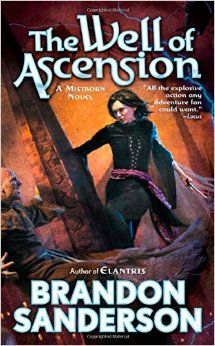
Review: The Well of Ascension by Brandon Sanderson (Mistborn Book 2)

Well of Ascension


Review: The Well of Ascension by Brandon Sanderson (Mistborn Book 2)

Short Review: A sequel that feels pedestrian and somewhat underwhelming until the reveal and twist ending.  An ending that saves the book.  A fascinating continuation and evolution of the characters from book one.


Actual Review:
Book 2 of Sanderson’s Mistborn series begins shortly after the end of book one.  The Lord Ruler is dead by Vin’s hand, Elend is now king of Luthadel but has set up a quasi-democratic council to rule with him, a new religion has sprung up that worships Kelsier ‘The Survivor’, and several armies are descending upon the capital in order to seize the fabled atium reserves of the Lord Ruler.  As one would expect when the despotic tyrant of an empire dies, there is chaos across the land as nobles vie for power and control.

The second book of a trilogy, as this initially was before the series began to build larger, can often be something of a problem child for authors, but Sanderson’s narrative moves the story along without any of the usual signs of trouble even if the pace and focus of the story are very different to The Final Empire.  Eschewing the great caper storyline of the first novel, Sanderson instead focuses more on the political turmoil created by the death of the Lord Ruler and the subsequent collapse of the empire he had ruled and controlled with ruthless efficiency.  So rather than producing more of the same, Sanderson gives the reader something that they didn’t know they wanted, a story about what happens after you kill the Dark Lord™.   And rather than ‘they all lived happily ever after’, things seem to go from bad to worse for our intrepid rebel alliance.

While still the central character, Vin is no longer the sole focus of the story and she now shares narrative space with Elend and the Terrisman Sazed, as well as my favourite, the kandra shapeshifter.  For some readers this shift into a split focus may rob them of some enjoyment, particularly if they had built up any great attachment to Vin.  But Vin’s journey in book one from street urchin to extremely powerful and competent mistborn didn’t have much further to go in that vein, so the change to focus more on her competence and character growth, rather than her abilities is a welcome development.  More so as she finally gets paired with a genuine challenge in the form of Zane, a fellow mistborn, who seems just as at ease with allomancy as she is, and is accompanied by the kandra, OreSure, who acts as both sidekick and foil to Vin.

This shift in focus leads to Vin developing as a character, rather than pushing the over-arching plot along, and as mentioned, may make her sections seem less essential than before, although no less action packed.  She gets embroiled in numerous scrapes and battles, and Sanderson doesn’t exactly shy away from using her as an action set piece.   In fact, in comparison to the first book, Vin’s body count in this seems a lot higher.  The trend being representative of the fact that she moves from young trainee and apprentice, to active agent, assassin, and bodyguard, in effect, growing up.  While there were sections of Final Empire devoted to the slightly tedious and repetitive ballroom scenes in which Vin dabbles in ham-fisted court intrigue and gossip, in this book she devotes her time to being mistborn and embracing her more destructive skill-set.  This change provides most of the much needed action and excitement in this novel, and with OreSure, much of the witty repartee.  So it isn’t really a bad thing at all.

One of the most surprising developments in this novel is how the character of Elend evolves.  While somewhat nondescript and wet in the first novel, and fairly unconvincing as a love interest for Vin, his character arc and development here is extremely welcome.  Rather than assume that he automatically grows into his leadership role as some destined hero, Sanderson brings in another Terris character, Tindwyl, who takes it upon herself to instruct Elend in the ways of kingship.  Her lessons with Elend and his slow growth into a strong king form a solid plot thread that ties the political arc of the power struggles in Luthadel together.  The amateurish, arm-chair revolutionary dilettante of book one is slowly replaced over the course of the novel by a leader, a king, a man of character.  This development of his character, punctuated by Tindwyl’s acerbic comments and with all Elend’s growing pains exposed, forms a fairly fascinating story as he painstakingly ‘fakes it until he makes it’ and becomes the leader Luthadel desperately needs.

The change in Vin’s storyline to a more action-oriented one, and the focus on the development of Elend as a leader make for some fairly engaging and interesting reading.  While very different to the caper-focus in the first novel, this is actually entertaining and fun.  They both grow into believable characters who demonstrate a growing depth and complexity that was somewhat missing from the first book in which their characters were predominantly defined by their function and role within the story.

But the book is not all good news.  A strange issue arises in the fabric of this story.  Elend’s plan for a democratic republic, or at the very least a democratic council of regents, falls flat.  A combination of self-interest, corruption, ignorance, and ambition leads the council to fail and Elend is voted out of office.  But rather than leave it there Sanderson has Vin step in and essentially place Elend on the throne as Emperor and Dictator through the use of magical and physical force.  In effect making Elend a tyrant emperor… like the one they spent all that time overthrowing in the previous book.  In his defence, Elend has only the best of intentions and is doing it for the good of the people and the country, and we can trust him because he is the good guy.  Uh huh.  Yeah.  Sure.

I think that this is one of my problems with this novel, the undercutting of each storyline in a way that negates its relevance.  If Sanderson’s characters had cause to question their becoming the very thing they rebelled against, instead of paying lip-service to the idea but dismissing it because they, the narrative, and the reader accept them as heroes, then this would be very clever.  But Sanderson just nods at this occasionally without ever actually engaging with it.  In fact, the narrative gose to show that they are right and justified in establishing a tyranny.

Sanderson goes to great pains to outline Elend’s benevolent desire to create a just and representative government and then, by the end of the novel, has him, supported by his powerful friends, overthrow it and seize power.  And we, as readers, are meant to agree with this.  So the novel reads as fairly anti-democracy as it will always be corrupted by cronyism, avarice, and ambition, and is actually pretty pro-tyranny.  Elend’s position as a tyrannical ruler promises to be efficient, direct, and because he is a good man, relatively fair, at least from the point of view of someone who agrees with his position, like Vin… the person who makes him Emperor.

In the first novel it is clear who the good and bad guys are, or at the very least, who the sides are and which side we are meant to root for.  Even if by the end things grow more complicated, the struggle is clearly delineated.  But in this novel, the bad guys are dispersed, threatening but not really evil or even that worrisome.  The stakes seem less high, less relevant, and less specific.  The main reason Elend opposes handing the city over to any of the lords leading the other armies is so that he can protect his new type of democratic government… that he himself then is part of overthrowing.  For their own good of course.  Elend wants to protect the freedom of the skaa and all the citizens from a tyrannical dictator who will simply take control and rule them… the way he does at the end.  The political storyline then completely disappears in the dying pages of the book to be replaced by the overarching mystical storyline that, until the end, has been fairly sketchy at best.  So it feels like the majority of the book was simply killing time for an all-important magical scene at the end, and therefore the ramifications of the politics are actually inconsequential, the characters actions are inconsequential, the majority of the developments and plot points are inconsequential.

Actually, the Koloss themselves, the mercenaries who make up one of the armies, also bothered me a little in this novel.  Newly introduced in this story they are presented as violent, savage, practically mindless, dumb brutes; they are monsters.  Sanderson then tries to make them more interesting and perhaps sympathetic by showing how they are being manipulated and used by one of the lords.  Ah ha, so this is going to be like the skaa storyline about freeing an oppressed people?  Nope.  Vin swoops in at the end and simply takes control of them, mind and body.  For their own good of course, and for the good of the people of Luthadel.  Never mind that this is a complete invasion and violation of their agency in a way you would think that the scrappy insurgents from book one would rally against.  The Koloss have even less power and freedom, and even fewer rights than the skaa, but they are a monstrous threat, so apparently it is fine that Vin uses them as living weapons and imposes her will on them.  So it is a good thing that Vin, just like Elend, is a good dictator.

Because of all this I am left wondering at what the moral centre of this story is meant to be.  The first book was a clear struggle for the freedom of the enslaved skaa by a ragtag group of rebels and rogues.  To depose a tyrannical ruler and encourage self-governance.  To remove the corrupt and decadent nobility who profited from the oppression of the people.   Yet each of these positions is essentially negated by the actions of Vin and Elend by the end of book two.  Elend, a noble, is now emperor with magical powers (something that has worked out so well in the past for Luthadel).  The skaa are indeed free in that they are no longer slaves, but have no say in how they are ruled, and have been pretty much left to fend for themselves with no money or means to actually find a place in society.  The nobility, while reduced in influence, still hold almost all the power, wealth, property in the land, and are the only ones who have had access to education meaning that they will continue to lord it over the rest of the populous.  So after overthrowing the Lord Ruler, Vin et al essentially set up almost entirely the same situation, but with less competence, experience, or effectiveness.  The major change simply being that they are now the elite power living off the people.  This is a fairly depressing outlook on life, ‘hello to the new boss, same as the old boss.’  While no doubt more ‘realistic’ than the heroes winning the day and succeeding, it goes against the narrative grain constructed by the narrative tone and perspective.

Then we come to the dénouement, the conclusion of this particular volume.  The enemy armies are threatening and meant to be impossible to beat, but rather than having a plan to defeat them that Elend, Vin et al will execute as a team and that has a slim chance of winning, once again it comes down to a magical save in the 11th hour.  So the whole point of having Elend set up a council, learn to be a great leader, and all the political posturing comes to naught and has almost zero impact on the actual story.  To have a deus ex machina end this book as well as the first one does not bode well for the series.  Especially as the idea of three hostile armies threatening each other and the city should have proved fertile ground for intricate political manoeuvring and Machiavellian intrigue.  What Sanderson leaves us with is closer to high school politics and ham-fisted, juvenile intrigue, rather than imperial statesmanship as each manoeuvre ultimately has almost no real bearing on the narrative.  That isn’t to say that the battles and fights aren’t fun to read, it is just that it seems to come down to Vin having super-special magical powers and just so happening to stumble across a magical secret in the nick of time… again.   So rather than the other characters actually being effective, there being real consequences to the heroes’ actions, and there being a discernible reason for the plot of three quarters of the novel, everything hinges on a surprise ending.

While much of this will no doubt be built upon in the third book, at the end of book two I wondered why I was meant to be supporting these characters at all.  Vin is a murderer and assassin, Elend has become a dictator, and the majority of the book has focused on a storyline that has almost zero relevance for the important reveal at the end.

But it is here that Sanderson saves the book.  The reveal.  The twist.  The all-important over-arching magical narrative.  Were it not for this I would have been extremely disappointed in the ending as it panned out.  While I might call shenanigans on the use of deus ex machina and immaculate timing yet again, it is nonetheless an intriguing end.  An ending that makes me want to read the third book immediately.  And isn’t that what a good story is meant to make you do?  Admittedly, although the fact that the book requires a twist ending that mostly comes out of nowhere to save it might seem a cheat, there are enough hints, references, and intimations dribbled through the book to make it seem a natural part of the world and overall story arc.  Even I will admit that I was hooked on finding out what was going to happen next.

But ultimately I thought that this was a fairly uneven book.  The early storylines that held my interest turned out to be fairly meaningless for this novel.  The hook and twist ending, while vital for the series as a whole, made the majority of the book’s action seem irrelevant filler, even if it did ensure that I immediately queued up the next instalment to read.


Review: The Sandman Overture by Neil Gaiman with JH Williams III

Sandman Overture


Review: Sandman Overture by Neil Gaiman with JH Williams III (artist), Dave Stewart (colour), Todd Klein (Letterer) and covers by Dave McKean


Sandman Overture, like all the Sandman stories is a wonderful collaboration between Gaiman as author and the artists and comic professionals who bring the story to life and give it the distinctive visual vibrancy and immediacy one has come to expect from the series.  Indeed, despite my great admiration for a lot of Gaiman’s work, were it not for the artistic input from his collaborators this 6 volume story would have lacked a lot of its punch.


If you are already familiar with The Sandman you can skip this paragraph.  The central character of the series is Dream, one of the Endless.  The Endless are the anthropomorphised expressions of abstract ideals that through their existence define the universe.  Destiny, Death, Destruction, Dream, Desire, Despair, and Delirium.  Each of the Endless are immortal, for a given value of immortal, and each has enormous power, especially within their sphere of influence.  For Dream, that sphere is, of course, dreams, but more than that, it encompasses fiction, stories, narratives of all sorts, and, to a certain extent, reality.  Because by defining the unreal we know that the real exists as all else.  The Sandman series officially ran from January 1989 to March 1996, and was followed by anthology editions, and several spin-offs and related titles.


Sandman Overture is a prequel (what is with the popularity of prequels these days? Are we so afraid of moving on that we want more of the same?) and focuses on the events that immediately precede the opening of the first issue of The Sandman or the opening chapter of Preludes and Nocturnes.  So essentially it tells the story of what weakened the character of Dream so much that he could be caught in the spell of the Victorian occultist Burgess that began the series back in 1989.  Throughout its pages it drops hints and mini-reveals that add resonance to the main series, and, to some extent, explore the relationships of the Endless.  It is an essential purchase for The Sandman completist or collector, but in many respects it is a bit of a let-down.  Given Gaiman’s great strength as a short story author, and his command of this material, this universe, and this character, I have to admit that my expectations were high.  Perhaps too high.


Gaiman’s Sandman has never been afraid to eschew standard narrative conventions and a fair number of issues have been as experimental as any modernist novel, so it is somewhat disappointing that the story presented here, despite appearances, it actually fairly pedestrian and prosaic.  The plodding travelogue, barely spiced up by exotic locales, moves inexorably toward a climatic finish that is robbed of power through the use of a plot device already seen in the main series, a deus ex machina, and, reader foreknowledge of the outcome… it is a prequel after-all.  We already know that Dream wins out, albeit in a weakened state, so much of interest is in how he wins out… which, unfortunately, is why the already used and heavily foreshadowed plot device and the deus ex machina are so disappointing.


To be fair to Gaiman, in many respects his hands were tied about what he wanted to do with this story.  It had to fit existing continuity, it had to end a certain way, and, if he wanted to please fans, it had to contain nods and cameos of certain characters and story elements.  No matter how high he wanted to raise the stakes, no matter how cataclysmic he made the challenge to Dream, the story was still going to end up in the same place.  This is, unfortunately, one of the major problems with many prequels, particularly those set just before the events of a well-established series.  So it is hard to fault Gaiman here, as there was little he could do about this particular aspect.  Therefore, unless you have almost no knowledge of the main series, there is very little dramatic tension present, at best there is some curiosity.  But, if you have no knowledge of the main series, much of the detail, context and required knowledge for unpacking the story is absent as few characters are explained, few relationships are actively detailed, and context is a thing left far, far behind.


This lack of context for readers unfamiliar with the main series makes the story fragmented and disjointed, full of characters who appear and disappear without meaning or context, and therefore it doesn’t really function as an entry to the main series.  So for the un-initiated it paradoxically appears to be both a simplistically linear travelogue and a strangely broken and nonsensical journey that lacks context.  For the initiated it is both a strangely pedestrian story, and delightfully insightful in regards to the storyworld, as it caters to the encyclopaedic need to know more about the world, and yet moves inexorably to a known conclusion.


It really is a case of damned if you do, damned if you don’t.


However, for those familiar with the series there are lots of details and nuggets of information and context revealed in this volume that will probably make you want to re-read the whole series from start to finish yet again.  This is definitely a volume that is an addition to the main series, rather than a stand-alone story.  Small moments in this story are deliberate nods and developments (or pre-echoes, as it is a prequel) of moments and character revelations in the main series.  The story itself is the expanded version of something actually referred to in the main series, giving a feeling of deepening the diegetic reality and building the world and universe out deeper and wider.   Yet… and yet… the story remains deeply underwhelming, bland and prosaic.  Where the main series followed Dream on a gigantic character arc that fleshed out his character and revealed his fatal flaws, and it jumped around backwards and forwards through his timeline letting us see multiple aspects of Dream, this is a fairly static portrayal of the character, locked in the least sympathetic aspects of his personality.  The emotional resonance of the main series is missing, primarily because you cannot deliver the same impact in six issues that you did over a long running series.  But while many of the individual issues of the main series focused on the stories of other people with Dream as a character in them, this focuses almost solely on Dream, and as a result adds information and background, rather than depth to his character, because Gaiman cannot change him here, his future is already set.


This lacks the style and power of stories like ‘Ramadan’, or the historical meta-commentary found in ‘A Midsummer Night’s Dream’, it lacks the narrative cohesion of The Dream Hunters and seems more like the fragmentary stories of Endless Nights without the framing of a story anthology.  It is burdened with the need to live up to an epic story cycle and to do so in only 6 issues whilst touching on cameos and appearances that will delight fans of the series, and it is just a shame that it does so at the expense of the story.


Perhaps one of the most damning aspects of the whole story is that it reduces Dream’s main series arc into one of simple predestination devoid of freewill and character growth.  A ramification that may or may not have been intended.  Certainly, it was an aspect of the main series that inspired debate and posed the question about inevitability created by decision, and inevitability created by fate.  However, in this volume, Gaiman comes down heavily on the pre-ordained, fate aspect, and therefore robs Dream’s character of agency and freewill in the main series.  This might not be a big deal to some, but to me this diminishes Dream as a tragic figure and turns him into an empty puppet.


But the comic is collaborative effort, and it is the artwork that really sells this volume and makes it worthwhile.  JH Williams III along with Dave Stewart present the reader with intricate, varied, and stunning pages and panels, that run the gamut of artistic styles.  You will be hard pressed to find a single page that exemplifies the book, except in terms of quality.  The book really does look gorgeous and it leaves you wanting a massively oversized version so that you can really take in all the detail.  While some of the pages and panel organisations cause you to rotate and spin the book in your hands, trying to puzzle them out, other are simply visual feasts that your eyes can devour again and again.  So many of the pages play with lay-out, panel design, and eye-tracking, to make you look, read, and look again.  This book is worth the purchase price for the artwork alone.  This is a book that engages the eyes, that challenges the brain, and that makes you pore over every page to take in the detail and sumptuous colour.


In summary, unless you are already a committed fan and collector of all things Sandman or you are a fan of beautiful artwork , this isn’t a great graphic novel.  But if you love artwork, if you love The Sandman then I am assuming you have already bought this and added it to your collection and won’t care about this review.


“Let’s hunt some Orc!’ – Re-evaluating the Monstrosity of Orcs

Orcs from Jackson's Adaptation of LotR

With the exception of Dragons, one of the most recognisable ‘monsters’ of genre fantasy is the humble Orc.  Orcs, commonly found in hordes™, are the disposable foot soldiers of every evil wizard’s army, and are useful opponents/victims for would-be heroes-in-training.  They are evil, barbaric, ugly, brutal and, above all, monstrous.  But given the trend of modern Genre Fantasy to move away from simplistic moral polarities to more complicated moral relativistic positions, can we still treat and react to Orcs in the same way?  With some notable exceptions, Mary Gentle’s Grunts (1992) and Stan Nicholls’ Orcs (1999-present), the treatment of Orcs has remained fairly consistent ever since Tolkien popularised them as the enemies of the hero.

Using established critical techniques already associated with the fantastic, in particular the Monstrous Other, Otherness, and the psychological readings of Monstrosity, the position of the Orc will be established in the context of the genre.  Then, by examining how the Orc has been used in related fantasy media, such as the RPG, it will be shown how the function of the Orc has changed into a ‘disposable’ monster.  Lastly, with the Orc as a cypher for almost every evil sentient monster deployed in Genre Fantasy, this paper will examine how we ‘read’ Orcs and suggest that the true monstrosity is the reader’s casual acceptance of racial genocide rather than the Orc’s position as Monstrous Other.

I took the idea of monstrosity as being constructed through a limited, subjective and external perspective and this therefore limits empathy with the subject.  By considering the narrative from the perspective of the monster we gain a new view of the story and of monstrosity.

With the exception of Dragons, one of the most recognisable ‘monsters’ of Genre Fantasy is the humble Orc.  Orcs, commonly found in hordes (Which I believe is the ™ term), are the readily identifiable disposable foot soldiers of every evil wizard’s or Dark Lord’s army, and they are the ever useful opponents for would-be heroes-in-training.    But given the trend of modern Genre Fantasy to move away from simplistic moral polarities to more complicated moral relativistic positions, can we still treat and react to Orcs in the same way?  Is it time to re-evaluate Orcs and as a result, the texts in which they appear?  Can we now view Orcs as the victims of the self-proclaimed heroes?  With some notable exceptions, Mary Gentle’s Grunts (1992) and Stan Nicholls’ Orcs (1999-present), the treatment of Orcs has remained fairly consistent ever since Tolkien popularised them as the enemies of the hero.

I am sure that everyone here is familiar with the Orcs of Tolkien’s world.  We could describe them as barbaric, evil, corrupt, treacherous, cannibalistic, and irredeemably evil.

In short they are ugly, snarling monstrous creatures.

Yet they are clearly also sentient, some are at the very least bi-lingual.  As Tolkien points out:

To Pippin’s surprise he found that much of the talk was intelligible; many of the Orcs were using ordinary language. Apparently the members of two or three quite different tribes were present, and they could not understand one another’s orc-speech.’ P.580 (The Uruk Hai – The Two Towers)

So clearly these Orcs speak at least two maybe even three languages: The black Speech of Mordor, their own Orcish language, and Common.

Therefore not all Orcs are the same.  There are different tribes with different languages, and given that language and culture are intertwined, we could at least argue that there may be significant cultural differences as well.  Certainly the most obvious example is made apparent between the Mordor Orcs and Saruman’s Uruk Hai, as the dispute between Grishnakh and Ugluk in The Two Towers clearly demonstrates.

But that conflict also proves that Orcs can evaluate social or group goals and needs in addition to their own personal goals and ambitions.  They have loyalties, can choose to follow orders and possess at least some element of free will.  They understand social and cultural hierarchy as well as individual positions of power.  Grishnak and Ugluk argue over what to do with the Hobbits, should they killed, should they be brought to Sauron, should they be searched.  There is tension between the Orcs as they struggle to assert personal dominance as well as the dominance of their respective allegiances and military hierarchies.

What is clear is that they can reason and explain their reasoning.  In effect, these are sentient beings, they are rational, thinking people… at least to some extent.

And while they appear cruel, at least by our standards, they feed Merry and Pippin their Orc-draughts to give them enough energy to keep running. In effect they demonstrate some level of compassion for their prisoners, minimal though it may be, and for which the motivations are not necessarily discernible or clear, as Tolkien does not investigate the Orcish perspective given his focus on the Human and Hobbit perspectives.  But these Orcs are not creatures, they are not monsters, and they are not dumb animals.

So where can we find stories that address this lack of Orcish voice, that give us the perspective of the Orcs, that tell the story from the Orc side of the war.

A book that purports to redress this balance is, of course, Mary Gentle’s Grunts!.

Gentle takes the Orcish perspective as a group of Orcs prepare for the great battle between the forces of good and evil.  However, this is not a ‘straight’ redressing of the imbalance of perspective, it is, from beginning to end a pointed satire or parody of a perceived stereotype of genre fantasy fiction, the great war.

Yet despite being a parody of the good versus evil cataclysmic battle/apocalypse, trope that appears in much early Genre Fantasy, Gentle does attempt to give voice to the Orcs, who despite being nearly ubiquitous in their appearance in diverse fantasy series, are a peculiarly voiceless and underrepresented fantasy race, narratorially speaking.

But this synopsis is slightly disingenuous.  While Gentle begins with a focus on the Orcish perspective she rapidly ‘alters’ the Orcs.  That is to say, by introducing an external magical factor, a geas or magical spell on the weapons the Orcs find in the dragon cache. She alters the Orcs, changing the Orcs from recognisable fantasy characters to caricatures of US Marines fighting a war in a fantasy world.

Barashkukor straightened his slouching spine until he thought it would crack. The strange words the big Agaku used were becoming instantly familiar, almost part of his own tongue. No magic-sniffer, he nonetheless felt by orc-instinct that presence of sorcery, geas or curse. But if the marine first class (Magic-Disposal) wasn’t complaining… He fixed his gaze directly ahead and sang out: ‘We are Marines!’. P.51

The introduction of an external force to ‘change’ the Orcs allows them to behave in different ways, to act contrary to their established fantasy characters and characteristics.  This is of course perfectly in line with Gentle’s focus and intention for the novel, to lampoon the ossified ‘Ultimate Battle’ motif that seems to recur with alarming regularity.

However, this means that the inversion of the Tolkien type Orc is used only for comic effect and does not actually attempt to give a voice to the Orcish world view, or attempt to actually investigate Orcs in anything other than parody.  In effect, Gentle’s work ultimately fails to provide the Orcs with their own voice, to represent their world view and it fails utterly to present the Orcs as an actual race of rounded developed characters.  Only their Marine characters and characteristics are given full voice.

Another narrative that purports to tell the Orc side of the story, is Stan Nicholls’ Orcs.  This is a series of fantasy novels which tells the story of a fantasy world’s battles from the Orc perspective, following the trials, tribulations and adventures of Orc Captain Stryke and his warband The Wolverines.  This series is not a parody, it is not a satire and it is not attempting to lampoon fantasy cliché.  For all attempts and purposes Nicholls appears to be writing the very thing I am talking about, a fantasy series from the perspective of the much maligned Orcs.

However, rather than using the narrative opportunity presented by Tolkien in The Two Towers, that is the rare insight we get to Orc internal politics and the tensions between Mordor Orcs, Mountain Orcs and Sarumans fighting Uruk Hai, Nicholls uses an old ‘bait and switch’.  In the first chapter the Wolverines are sacking a human village and come across a baby.

The cries of the baby rose to a more incessant pitch. Stryke turned to look at it. His green, viperish tongue flicked over mottled lips. ‘Are the rest of you as hungry as I am?’ he wondered.

His jest broke the tension. They laughed.

‘It’d be exactly what they what they’d expect of us,’ Coilla said, reaching down and hoisting the infant by the scruff of its neck. […] ‘Ride down to the plain and leave this where the humans will find it. And try to be … gentle with the thing.pp.13-15

Unfortunately the ‘gentle’ there is a coincidence.

Nicholls has done much the same as Gentle in that he has changed the Orcs to something much more sympathetic.  He has rewritten what an Orc is and in effect reduced them to another fantasy cliché, that of the noble savage, the barbarian tribesmen, the put upon native people who have an overriding sense of honour that has been abused by ‘evil’ masters. These Orcs are the unwilling servants of a Dark Power.

So again this is another attempt to redress the narrative imbalance of a widely used fantasy race that suffers from a seeming lack of ability to genuinely conceive of what Orcs are like, despite the fact that this is clearly evident from Tolkien’s work.

Yet there are examples in which Orcs remain Orcs and yet their stories are accessible, their point of view is articulated and they are given a voice.

While not exactly the most respected or critically examined areas of fantasy literature and narrative, D&D and the various worlds and fantasy series associated with it provide a fascinating perspective on the evolution of Orcs as a fantasy race.

What is interesting is that D&D had to confront an issue with Tolkien’s initial construction of the Orc.  If Orcs are sentient then why were they treated as monsters and not simply as enemies?  Early editions of D&D used Orcs in much the same manner as bad fantasy does, they were simply a stack of low level cannon fodder enemies to be killed off by the heroes to prove how wonderful Sir- Killalot and Princess Smack-them-in-the-head are.

However, as the game developed and grew increasingly more complex, in part to continue to expand the world so that players had greater variety and choice and therefore would keep buying more supplements and products, but also because as the fantasy world grew and the game developed it became increasingly more sophisticated and began to probe and investigate difficult areas of what is assumed to be a simplistic paradigm.  If you can have half-elves, half-dwarves, as playable characters etc… can you have half-orcs?

If you can have half-orcs as playable characters, can you have full blooded orcs as a playable characters?  How does Orc society actually function?  What are Orcs actually like?

In order to continually develop D&D for market, the company continued to add races and playable character types, including some that the confining ‘moral alignment’ rules describe as evil.  Orcs have gradually entered the game as a playable race, equal to and on par with Elves, Humans and Dwarves.

D&D is not the only game to do this.  Orcs appear as playable races in a number of Gamesworkshop products (Warhammer, Warhammer 40K, Blood Bowl, etc.)

However, the simple inclusion of something called Orcs (as Nicholls has proven) does not necessarily guarantee that they remain identifiable as Orcs.

So let us consider R.A.Salvatore’s Legend of Drizzt Series, a long running (and still ongoing) fantasy series concerning the adventures of a Drow (Dark Elf) and his companions.  In The Hunter’s Blades Trilogy {The Thousand Orcs 2002, The Lone Drow (2003) and The Two Swords (2004) (books 15-17 of the Legend of Drizzt series)} one of the major secondary narrative strings is a developing storyline about an Orc chieftain or warlord Obould Many Arrows.  Obould Many Arrows, is initially allied to a clan of Frost Giants and has amassed a massive horde TM. In other words he has called together a large military force or army… but as he is an Orc we are stuck with horde.

As the books develop his army manages to push the Dwarves back to the gates of the Dwarvish realm, Mithral Hall.  And the purpose of this conflict is to clear space in the foothills of the Dwarvish mountain range so that the Orcish clan can establish a genuine kingdom free from the interference of giants, dark lords, evil wizards etc. And so that Obould can open diplomatic relations equal to Elves, Dwarves and Humans.  In effect, to create a recognised Orcish sovereign territory.

What makes this interesting is not that there is an Orc horde, but that the purpose of their ‘invasion’ is actually to find a kingdom and land of their own.  They ‘push’ the Dwarves back to their own Kingdom… which without too much thought you realise means that the Dwarves can be redefined as evil imperialistic conquerors hell bent on wiping out another race in order to steal land and wealth.  Not that Salvatore does this, but the subtext is present.

The Orcs on the other hand are pushing the Dwarves back.  In essence containing an evil expanding army… The Orcs are not ‘stealing land from the Dwarves, the Dwarves live underground, they don’t need nor use the land above the mountain, the lower slopes of the mountain are free, unoccupied and not in use.

And the purpose of the Orc army is not to kill off the other races, it is not to destroy the forces of good, it is to create a consolidated home land where the Orcs can live free from persecution and being hunted down like animals.

In effect then, Salavatore has done something that Gentle and Nicholls could not, he has created a political, interesting and engaging storyline which considers and addresses the Orcish perspective without altering who and what Orcs are.  In hindsight it seems strange that no-one thought to do this before.  Yet the earlier examples given could not seem to conceive of the Orcs as anything other than monsters.

Returning then to the LotR with this new perspective of Orcs we need to reconsider them in this new light.  While Tolkien at least focused on the fact that Aragorn, Gimli and Legolas weighed their decision and chose to try and rescue Merry and Pippin at the beginning of The Two Towers, Jackson’s film adaptation is more revealing of my point.

When Aragorn turns to his companions and says with barely restrained glee ‘We travel light. Let’s hunt some Orc’[1] we can now see how this reduces a sentient and potentially ‘redeemable’ species to an animilaistic and monstrous fate.

But Jackson is not entirely to blame because aspects of this concept, this attitude, appear in Tolkien’s work.  At the battle of the Hornberg in Helm’s Deep Legolas and Gimli have a competition to see who can kill the greatest number of Orcs.  This friendly competition is presented in an heroic light and in the film adaptation is even a source of humour.

But if we consider this episode from this new perspective, counting the number of Orcs killed now appears as crass, distasteful and even malicious behaviour.  In effect it appears as a mis-guided glorification of the murder of enemies and rather than the joyous celebration of monsters put down.

Furthermore, in this battle the remaining Orc horde is herded into an indefensible position surrounded by the Ents and Huorns, who then, rather than letting them surrender, simply destroy them, off page, without a sound, without a murmur, without a second thought.   Tolkien describes this in fairly unambiguous terminology:

‘Wailing they passed under the waiting shadow of the trees; and from that shadow none ever came again.’[2]

Yet, while this is a cause for the heroes to celebrate, the Orcs were an enemy that need to be defeated, why do we as readers never once consider that this is the systematic extermination of a race.  That this is mass murder.  That this is attempted genocide.  The heroes might feel justified in their attitudes as such positions might be necessary in war and combat, but for readers, surely we should question the heroes’ actions.

The heroes do not take Orcish prisoners.

The heroes do not even set up forced labour camps or prisoner of war camps.  All enemy combatants, even if they are retreating or have surrendered, are slaughtered.

When it comes to honouring the dead, the heroes do not give the Orcish dead a modicum of respect or attempt proper funeral rites, rather they are stacked and burned or tossed into mass graves.

So if we have never questioned this it seems that we as readers, not actually involved in the war, tacitly or openly agree with the mass extermination of an entire species, we revel in the slaughter of a sentient race, we delight in the murder of surrendering enemy combatants, we never once treat Orcs as people, as a sentient species, as a race that may be on the other side of the war, but still deserve consideration and respect.

In short, Orcs aren’t monsters.  We are.

[1] The Lord of the Rings: The Two Towers (dir. Jackson, 2002)

[2] Tolkien The Two Towers Chapter 7 ‘Helm’s Deep’ p.707

(Originally delivered as a paper at ICFA 35 and a variant published in NYRSF)