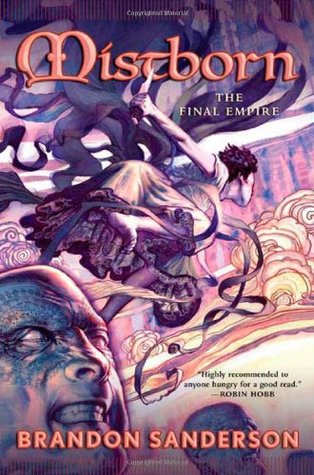
Review: Mistborn: The Final Empire by Brandon Sanderson

Mistborn Book 1


Review: Mistborn: The Final Empire by Brandon Sanderson

Mistborn: The Final Empire is book one of the Mistborn series, and part of Sanderson’s expanding, and increasingly intriguing, Cosmere universe.  It follows the adventures and coming-of-age narrative of young street urchin Vin, and her participation in a rebel plot to overthrow the ostensibly immortal god-emperor of the land, the Lord Ruler.

On the face of it Mistborn has all the markings of a walking fantasy cliché.

We have a young hero who it just turns out has incredibly and unbelievably rare super-special magical powers, and not only that, but has an uncanny affinity for them and learns how to use them absurdly quickly and to an extent that puts all others to shame.  Not to mention a secret bloodline that has ramifications for the upper echelons of society.

We have a scrappy group of super-talented rebels (or quest group for those that are familiar with RPGs) faced with an impossible task that you know that they are somehow going to pull off.  Sort of like a million-to-one shot that works nine times out of ten.  Luckily each member of the group has one specific talent that adds to the plan and pretty much defines them as a character.  For example, Breeze can soothe people’s emotions, Clubs can hide their allomantic activity, and Ham is incredibly strong.

We have the slightly sinister mentor, Kelsier, who, it turns out, has a few dark secrets in his past.  Thankfully he is lucky enough to take a chance on rescuing a young orphan girl, the super-special hero mentioned above, who becomes essential to his plan succeeding.

There is an immortal Dark Lord™ that has been ruthlessly subjugating the masses for a very long time, is obscenely powerful, and appears to be definitively evil for the sake of being evil (ruling with an iron fist, being mean to puppies, and guilty of living alone in a large, foreboding, yet tastefully ostentatious palace which possesses no chamber pots or bathrooms).

The society of the fantasy world has not really evolved or changed in hundreds of years with technology, fashion, literature, and science all remaining relatively static, and made up of two peoples; The Nobles, privileged, spoiled, and decadent, and the Skaa, oppressed slaves.

There is an evil corrupt government bureaucracy and evil military religion that maintain law and order in the land in cruel and vindictive ways.

And lo, there is also an ancient prophecy knocking around that must be fulfilled.

Now if there was an awkward and unnecessary romantic sub-plot and a dragon you would have a full house in fantasy cliché bingo… ok so there is an unnecessary romantic sub-plot but there isn’t a dragon.  Maybe even Sanderson thought that dragons at this point would have been overkill.

It is to Sanderson’s credit that he utilises these stereotypes knowingly, and provides enough subversion so that they don’t completely weigh down the narrative in ever increasingly obvious ways.  But in terms of story there is little here that will be of any surprise to a fantasy reader, until the end, but to give that away pretty much spoils the story.  In this case, the end, at least, partially justifies the means… so to speak.

Mistborn is set on the world Scadrial, a secondary world that is plagued by nigh continual volcanic ash falls, nightly planet-engulfing mists, and orbits a weak red sun.  Despite the seemingly alien nature of the planet and the occasional reminders about the ash and the mists, most of the book feels like it is set in a fairly standard and familiar pseudo-medieval fantasy world.  The strangeness of the landscape never quite leaves the page to enter the imagination, and there is a certain feudal European feel to the entire planet.  Given that worldbuilding is something so important to many modern fantasy narratives, and is also a frequent point praised in Sanderson’s work, perhaps a closer look at the world of Scadrial is necessary here.

The world essentially has two classes of people, the nobles and the Skaa.  The Skaa, although they physically resemble the nobles, so much so that they can be easily confused for them, are a slave race.  Sanderson didn’t use anything as clichéd as colour or some sort of physical characteristic to differentiate the two races, actually, he doesn’t really use anything to differentiate the two races apart from the name.  But choosing a slave race name based on a word for a type of Jamaican music is perhaps a little too on the nose for me.  Regardless, despite the fact that the narrative insists on, and then actually explains how, the two races are physically different, the narrative also depends on the fact that there is no real physical difference between them.  Yes, it is indeed that contradictory.

Oppressed and subservient to the nobles, the Skaa’s only hope lies in the Skaa rebellion.  For centuries a small pocket of rebels has tried to overthrow the Lord Ruler (Dark Lord™) without success.  That is, until, Kelsier, the survivor of the prison quarry, the Pits of Hathsin, returns to the capital, Luthadel, to organise an uprising.  He rounds up a crew of magically talented individuals, and in the process rescues the protagonist of the novel, Vin, from her time in an evil criminal gang, by recruiting her to his good criminal gang…

But luckily for the reader there is never any doubt about who to support as the Skaa are treated as slaves, apart from those Skaa who own their own independent businesses or are semi-successful merchants, but we never meet any of those apart from two of the main characters who are in Kelsier’s crew.   But the vast majority of Skaa are treated as slaves and are horribly abused by the evil nobles and therefore Kelsier and his crew are undoubtedly good freedom fighters, thieves, murderers and conmen.  Sanderson makes sure to show the Lord Ruler and his minions killing people in cold blood to prove a point and to cow the public, just like Kelsier does to the nobles.  Have I mentioned that there are some issues with the worldbuilding?

The world of Sadrial possesses two major forms of magic, the first, and the focus of the first novel, is allomancy, while the second, feruchemy is more important in the later books.   Allomancers, those gifted with this exceptionally rare ability, can ‘burn’ certain metals to create amazing effects.  Essentially they ingest small pellets of specific metals that create reservoirs of power that they can tap to create very specific effects, such as the ability to pull metal toward them, or push metal away from them.

Only the rarest of the rare Allomancers (alloy-mancer, like necromancer) can ‘burn’ more than one metal, and those few are called Mistborn, hence the title of the book.  As it turns out, almost the whole of Kelsier’s crew are Allomancers, it is what makes them so special and effective, and Kelsier himself is a Mistborn.  It just so happens that Vin, our hero, is also a Mistborn.  Given the tight focus of the novel on Vin’s adventures with Kelsier’s crew this gives the unfortunate appearance that almost every character has this exceptionally rare magical ability and therefore it is not rare at all in the novel.  But we are also led to believe that despite the fact that this is rare, there are enough noble allomancers that a strong enough trade in allomantic metals exists, and that Skaa workers are trusted enough to run these businesses* and there are enough allomancers that noble houses have entire houseguard squads made up of low level allomancers who wield no political power nor hold positions of authority within the houses.

(*While never explicitly stated that the metallurgists who provide the allomantic metals are Skaa no noble would risk buying their metals from another noble house that they may be at war with, and if Sanderson had each noble house produce their own allomantic metals then, no matter how logical this would be for the world, Kelsier and his crew would have difficulty in accessing the necessary supplies)

Sanderson is at pains to lay out and explore the strengths and weaknesses of this fairly original magic system, and if you enjoy reading about how different magic systems are used, then this will be a major strength of the novel for you.  A good third of the novel is focused on Vin slowly training, experimenting with, and growing to command her powers.  To give Sanderson his due, these sections are much more entertaining and engaging than comparable training sessions found in a multitude of other fantasy works.  Indeed the action sequences detailing the use of allomancy, both the aspects of training and later in combat, are extremely well executed with cinematic flair.

So as long as you don’t think too hard about the actual ramifications of the rules of the world, the physical descriptions of the people and the landscape, and the fact that the rules of the magic system become flexible according to necessity, and just go along with the flow, the worldbuilding in this novel is great.

But… and this is an important but…

But while much of what I have said thus far has been a little damning, Sanderson does weave a fairly compelling tale.  His prose trips along in an amiable fashion.  The character of Vin is engaging and interesting, and it is genuinely nice to have a central female hero who exhibits depth and backstory, and also isn’t raped.  Kelsier possesses some elements of moral and character complexity that become more apparent as the plot trundles on.  The crew is made up of colourful characters that round out the story and give it some interest as their sense of camaraderie is explored and they grumble and gripe at one another.

More importantly, it is the events and the central mystery of who the Lord Ruler is and why the world seems so strange and yet incomplete, that provide the much needed intrigue and interest.  The reveal and twists at the end of the novel are enough, even after all that I have said, to make me like the novel and read more of the series, as it turns out that so many of the clichés, the tropes, the ‘mistakes’ and weaknesses of the worldbuilding are very deliberately constructed on Sanderson’s part.  So much of what seems contrived and artificial actually plays a part in the broader context that the novel reveals in its last few chapters.

Granted, I will never rate this as among the best fantasy novels I have ever read, but Sanderson weaves a compelling story by acknowledging and engaging with the flawed nature of his world building, even if some flaws are perhaps unintentional, and focusing the story on explaining how this came to be.  And it is this surprising plot thread that convinces you to keep reading.  So rather than being an epic quest or a standard story about overthrowing a Dark Lord™, this is actually a mystery, and if you aren’t careful some of the cleverer aspects of the world will sneak by you.

Review: Assail by Ian C. Esslemont

Assail
Assail
(Book 6 Malzan Empire) by Ian C. Esslemont

Assail marks the culmination of Esslemont’s Malazan Empire series and is the final chapter of a series that has significantly explored and expanded the narrative universe co-created with Steven Erikson.  In this volume Esslemont has set himself a foreboding task in that expectations are always higher for the final novel in a series, even more so if the book is set in the most mysterious land of the fantasy world that has only ever been hinted at.  Luckily for readers, Esslemont delivers, although not necessarily in the way some might want.

The impetus for the main story of Assail is the revelation that the glacial coverage of the mysterious continent has receded sufficiently that previously impassable terrain is now accessible.  In fact, vast gold-fields have been exposed, prompting a mass rush to the land in order to exploit the natural resource.  As a result, all manner of people and groups are making their way to and through Assail including Imass, the Crimson Guard, prospectors, private armies, and long absent migrants finally returning ‘home’.

Assail
focuses on tying up the story of Kyle, the young guardsman first met in Return of the Crimson Guard, the Crimson Guard themselves and the investigation of their mysterious vow.  Another significant thread concerns the story of the Imass and Silverfox, which has woven through both Erikson’s Malazan Book of the Fallen as well as Esslemont’s series.  Lastly, there are two related threads directly concerning the continent of Assail itself.  The first is focalised through the perspective of Orman, a young warrior, and explores Assail from a native’s perspective, playing with perceptions of culture, tribalism, barbarism and honour.  The other is split between the various prospectors and outsiders hastening to stake claims and set up frontier stations and explores the foreigners’ perspective of Assail.  In particular the story of Reuth, a young navigator tasked with getting his uncle’s ship to the gold fields of Assail. Both the stories of Reuth and Orman parallel one another, while being neat contrasts of the different approaches to life, Assail, and the journey to adulthood.  They also create a strong resonance with the story of Kyle, both his introduction in RotCG, and as a reminder that even as one actor’s story ends, other agents in the world will continue.

However, each of these potentially disparate tales is interwoven and lends itself to a nuanced and balanced investigation of the continent and its cultures and forms a genuinely cohesive story.  Despite the focus on Assail itself as the setting and background of the story, Esslemont has included several sections that focus on the travelling to Assail, most notably the various sea voyages and what that entails for the prospective parties.  This brings a significant diversity of story mode, setting and even genre to the book that otherwise might have superficially appeared to be a fantasy travelogue of a Scandinavian influenced continent.

Starting with some obvious points that nonetheless need noting.  As with the other novels in the Malazan Empire series, the style is once again a narrative told through multiple point of view characters.  While several of these characters are key to the narrative, Esslemont also uses witness characters to provide perspective on the events from outside the key actors’ perspectives.  As a result there is a pleasing change of perspective as instead of always sitting on a hero’s shoulders, the reader now has access to a broader narrative palette.  This is particularly interesting when you consider that this allows Esslemont to demonstrate how the events of the story reach further than just those acting or being acted upon.  Such a broadening of scope has the effect of consolidating the world-building (diegetic reality) and adding to the impression that the story-world is ‘real’.  It also neatly dovetails with Esslemont’s own background as an archaeologist and anthropologist who sees history as an interlocking system of events and not solely the result of the actions of a few great men.

Structurally Esslemont writes true to form with most of the first third of the book being used in set-up and foundational work.  He carefully re-introduces old characters (from his previous novels and from the wider Malazan universe) while also introducing some new characters to the story and familiarising the reader with the new setting of Assail.  By creating a pleasant blend of the familiar with an enticing mix of the new, the leisurely pace means that no reader is left behind.  This is not to say that there aren’t some interesting set pieces and action sequences along the way, but both Erikson and Esslemont are known for their deliberate crafting and building in the earlier chapters of their novels in order to set the board for grand finales.  The second third of the novel starts moving the various pieces around as the characters reach and explore the continent of Assail, tracking their interactions and near misses, and building toward the last third of the novel which handles the convergence of events and the resolution of the story and series.

It is with the last third of the novel that Esslemont both conforms to and defies his standard structural approach.  The last third of the novel contains multiple scenes of battle, action and a convergence of events, but if it is an all-out battle ending that you are longing for, you will be disappointed.  What Esslemont delivers is, in almost every way, far more satisfying.  He brings home multiple story threads and characters from throughout the series in an emotional and narrative convergence that provides a sensitive and resonating narrative closure.  While this is probably something of a risk for Esslemont given the desire in many fantasy fans for blood, gore and battle by the ever increasing bucket full, that he pulls it off should mark his increased prowess and command as an author.

It is of no surprise that the world of Assail is exquisitely realised.  In Blood and Bone Esslemont depicted the sweaty, steamy closeness of a jungle landscape with such clarity that it became a character in and of itself that was integral to the story.  In Assail, the various landscapes, climates and scenic types deployed by Esslemont are rendered in a beautiful cinematic language that gives a visceral quality to the description and helps lift the narrative off the page.  The various landscapes and settings reveal several influences on the book and have been well tied to the various themes and plots running through the volume and series.  Notably, the Odyssey and Sinbad inspired sea and sailing sections, in which several different attempts to reach the continent are described and reveal the dangers of even trying to get to this part of the world.  The wind-blasted, desolate coastline that emphasises the unwelcoming and foreboding nature of the land, but also the isolationist nature of the population and how cut off this is from the rest of the world.  The long rolling prairies and plains of Assail that evoke a sense of Esslemont’s Canadian homeland, a land that appears lush and welcoming, but has hidden dangers, and, like the beaches, emphasises the unwise and unwelcome intrusion of people into a world and space that does not want them.  But it is with the Alaskan and Scandanavian inspired mountains and glaciers that the book really finds a defining landscape that evokes the true nature of Assail.  The terrible beauty of the biting cold, the virgin forests filled with snow, the blues, greens and whites of glacial flow.  This is a harsh, pitiless, unwelcoming world to the human invaders, but a beautiful, sublime home to those people who live in concert with the land.   Each of these landscapes has been rendered with an eye for cinematic description that evokes the transcendentalist sense of nature’s beauty, as well as the brutal reality of inhospitable climes.

This descriptive backdrop neatly fits with the detail of the wider world which is also superbly rendered, in part due to the early books in the series, but also due to Erikson’s Malazan Book of the Fallen series which features the same world.   By building on what has gone before, and assuming the reader’s foreknowledge of the world, Esslemont has been able to focus on what lies directly around the characters and this has led to a style that creates a perception of the fictive reality as something witnessed and existing, without needing to utilise endless exposition or overly-long descriptive passages.   The assumed knowledge is not necessary to enjoying the story as it unfolds, but it does add significant depth, breadth and colour to the story that uninitiated readers might miss.  As the narrative builds on this realised world and weaves the characters and their actions into it in order to build a cohesive story that reads and feels ‘real’, ultimately, it results in an immersive reality that the reader witnesses through the perspectives of the various point of view characters and creates a believable, solid weight to the story world that helps sell the more fantastic elements.

Given that the impetus of the story is based on the revelation of suddenly accessible gold-fields, and that the glaciers have retreated and exposed hitherto impassable sections of this relatively pristine land, there is a strong element of the frontier gold-rush myth to some of the storytelling.  While frontier stories are not that uncommon, the parallels to the current attitudes to exploiting natural resources in Canada and the US certainly form a strong undercurrent to this aspect of the story.  Esslemont’s description of the frontier mentality has far less of the noble mythos that has surrounded American gold rush stories, and presents a vicious reality about the unscrupulous plundering of natural resources over the objections of natives and indigenous inhabitants.  There is a strong suspicion that his experience of current mining and oil drilling in Alaska may have influenced some of the elements in the story.

The matter-of-fact destruction of natives and native environments by outsiders, in the name of progress and financial greed, is contrasted and compared to the tribal conflicts of the native inhabitants perpetrated on one another in the name of tradition and blood feuds, which are anything but dispassionate.  Esslemont succeeds in creating a credible series of tribal cultures and relationships that balance the tropes of the barbarian and the noble savage with a more objective perspective in an attempt to convey the complexity of tribal and clan societies without overly venerating or damning them.  These violent, destructive story threads are held up in comparison to the logical extension of their core premises in the story of the Imass and their genocidal pogrom sweeping through the land in an effort to cleanse a perceived racial taint.

As a series generally conceived of as high fantasy adventure epic, these are weighty, divisive and loaded issues that one would not expect to find.  However, part of Esslemont’s talent as a writer is to weave these contemporary concerns into his fantasy narrative seamlessly and make them appear as part of the very fabric of the fictive reality.   Not only that, but many aspects of these issues are presented without authorial comment or overt bias, letting the reader absorb the facets of the conflicts and appreciate the factors that led to characters making these decisions.  There are few obvious antagonists or villains in the story.  Indeed many of the foes faced by the characters are sympathetically or realistically presented in an effort to show the moral complexity of world, while the characters themselves are not always on the side of ‘good’.  Assail is a book of characters, not a book of heroes and villains.  By not directly signalling good or evil, and steering clear of fetishizing violence and idolising dark anti-heroes it may be that Esslemont has created too realistic a moral universe for his readers and some will overlook the actual complexity of morality at play.

Over the last few years Esslemont has faced significant and vicious criticism from many fans of Erikson’s Malazan series.  His work has been viewed or even dismissed as a companion piece to the real series.  His portrayals of characters and places in the world have been dismissed as less than authoritative.  His strengths as an author have been overlooked and his weaknesses have been exaggerated.  Despite this, Esslemont has continued to produce fantasy novels that exemplify the best that fantasy series have to offer and has continued to improve as a writer, an author and as a storyteller.  With Assail Esslemont has written a fascinating, thoughtful, exciting and engaging read.  It is a fitting finale to the Malazan Empire series, and a great book.  He masterfully weaves myth, legend, character, land and story together to create something that fulfils expectations but remains engaged with concerns of our own world.  He has always stood shoulder to shoulder with his co-creator, Erikson, but perhaps now he himself will believe it.

(Originally reviewed in NYRSF)

Review: Blackdog by KV Johansen

Blackdog

Blackdog by KV Johansen (Pyr, 2011)

Whilst an established Canadian author of children’s sf and fantasy novels, Blackdog marks Johansen’s first foray into epic fantasy. The novel focuses on Attalissa, a goddess re-incarnated as a young girl, and her protector, the titular Blackdog, a spirit that possesses human hosts, as they attempt to deal with the threat of a powerful evil wizard who is attempting to consume the goddess’s power.

On the surface, it appears to have all the elements of a great epic fantasy: cosmic conflicts between good and evil, multiple character perspectives interweaving into a grander narrative tapestry, fascinating hints of legendary backstory and a diverse world setting. Unfortunately Blackdog does not quite live up to its promise since these elements never quite cohere. The story does not seem to know which it would rather be; a gentle, intimate tale following the coming-of-age of the young goddess incarnate or an epic battle between vast supernatural forces. In trying to be both, it has succeeded at neither.

An illustration of this concerns the Blackdog himself. While he is the eponymous character, the narrative vacillates unevenly between his role as guide and protector, reducing him to the position of supporting companion, and the exploration of his ‘curse’ and his repetitive struggles to overcome it.  Indeed, even the character development concerning Blackdog will disappoint most, as all the twists and turns are heavily foreshadowed and never surprise.

Disappointingly, the world and story are told to the reader, rather than shown, resulting in a feeling of thinness and lack of texture. For a book of some 540 pages there is a surprising lack of detail, as plot, action, world building and character development are sketched rather than explored. The plot itself is simplistic, banal and so heavily foreshadowed that there are few, if any, surprises. The shifting of narrative focus between the personal narratives and the larger plot leads to both feeling lamentably underdeveloped. The climax of the plot is overly neat and split between the straightforward coming-of-age narrative and the obvious, underwhelming grand battle. When the disparate elements finally collide, it creates a sense of forced artifice rather than natural convergence.

In terms of action, there are few battles or fights and those included are hastily passed over and never approach ‘epic’ in nature. There is little tension in the short sequences and almost no sense of the viciousness of battle or the emotional repercussions of loss and death. While great authors can evoke much with simple descriptions, Johnasen never gives the reader the page length to fully immerse themselves in the action, and seems more inclined to skip over action sequences in favour of more bland character interaction.

This blandness affects the world itself as there is no real distinction drawn between the various locales, regardless of the radically different terrains.  For a novel that traverses various locales, including desert, steppes, foothills and mountain tops, there is almost no real variance in how the world appears or is described.  In fact how the characters interact with their surroundings and feel about the various landscapes is uniformly mundane.  No matter where they are, each of the characters acts in exactly the same way, and it is seems a missed opportunity to explore the richness of the world that Johansen has built.

The characters are rarely distinctive and very few are developed beyond stereotypical or function-driven roles. Those few interesting characters are inevitably underused and underdeveloped. However, a major point in Johansen’s favour is her treatment of sexuality as she seamlessly integrates non-heterosexual characters into her world in a subtle display of acceptance without the use of gratuitous sex scenes or heavy-handed narrative underlining.

Two minor characters in this novel, Moth and Mikki, are the most interesting of the bunch, primarily because something is left to the reader’s imagination and their backstory is not painstakingly delivered as exposition.  However, due to the fact that they are indeed minor, they are not really a selling point of this novel, although seeing them in later books would be great.

While Blackdog is not good as it falls short of both YA and Epic fantasy, it is inoffensively mediocre and tediously predictable rather than truly abysmal.

(Originally reviewed in Vector)

‘Awards or Bust’ Guest Blog by Steven Erikson

erikson_fiAwards Or Bust

by Steven Erikson

A commentary on the World Fantasy Awards Committee’s decision to replace the Gahan Wilson H. P. Lovecraft bust.

This past weekend I sat at a table during the banquet and awards ceremony at the Saratoga Hilton, as Guest of Honour for the 2015 World Fantasy Awards.  This was where the announcement was made official: the WFA was bringing to an end the H.P. Lovecraft bust given annually in recognition of a host of exemplary accomplishments within the field of Fantasy literature and related media.  The bust’s replacement is yet to be determined, and without doubt will be selected with the WFA’s philosophy of inclusiveness and diversity foremost in mind.  The applause in response to this announcement was loud and effusive.

In a fit of contrariness I had elected to attend the convention without my laptop, and with my phone on the fritz I found myself essentially incommunicado with everyone but those whom I met and hung out with at the convention.  Returning home, however, I found on my Facebook page a commentary on the WFA’s decision, written by the multiple WFA winner Steve Jones.  Accompanying the commentary was a photo of three Lovecraft busts.

I quote his comment here:

“I am inordinately proud of my three World Fantasy Awards. I am proud of the work and the body of work that I won them for. I am proud that they are a stylised representation of H.P. Lovecraft – one of the most influential and creative writers of imaginative fiction the genre has ever known. I am proud that they are nicknamed the “Howie” award after that other influential giant of fantasy literature, Robert E. Howard. And I am proud that they were designed and sculpted by Gahan Wilson, a founding member of the World Fantasy Convention and one of our most talented artists and authors in the field of the macabre. It is an honour to own and display these awards in my home. What I am not proud of is the World Fantasy Convention Board and their cowardly response to a small but vocal minority of people who have no sense of history or tradition. Censorship – in all its malicious and insidious forms – is always reprehensible. Let him (or her) who is without sin cast the first stone . . .” (Steve Jones)

This statement earned plenty of ‘likes’ and the reply stream was extensive, with a mostly unanimous rendition of ‘hear hear’ and similar affirmatives.  And among those replies I found the common list of such terms as ‘social justice warriors’ (and indeed, even ‘social justice bullies’) as well as ‘political correctness,’ both used in their modern pejorative meaning.  The contempt and disdain veritably dripped.

Over my morning coffee, I sat at the desk, laptop open before me, and simply stared, dumbfounded.  My wife took note (that in itself a miracle of sorts) and asked me what was wrong?  I stumbled to answer, and in the end could only shake my head.  It’s now a few days later, and Steve Jones has since added to the topic with a poem, further indicating his objection to the WFA’s decision, and yet more replies and ‘likes’ have piled up on that post.

Normally, it’s in my nature to let these debates slide past me, to leave people to their opinions.  Most of what I have to say, I say first and foremost through my fiction, and even in that context, not in terms of opinions or agenda, or didactic polemics disguised as fiction.  I am by nature inclined to question and hold to a deep-seated suspicion of certitude, especially when it comes to human affairs.

That said … holy crap.

Symbols are potent things.  Before I expound on the relevance of that statement, let me first make the following distinction, because not only is it important, it is also essential to the point I am about to make.  The past winners of the WFA are among a select few: their accomplishments in the field are exemplary and impressive.  Steve Jones (and all the others) earned their awards for their extraordinary talent and effort to advance Fantasy (and related) literature – as writers, editors, publishers and as fans of the genre.  This is not in question, and nothing related to the Lovecraft bust should in any way degrade or discount their exceptional merit as recipients.

But I will say it again: symbols are potent things.  As the physical, durable manifestation of a community of peers’ recognition for achievement, they should in every way reflect the inclusiveness, the diversity, and the unmitigated adherence to merit above all other considerations.

Lovecraft was a poet and storyteller of the macabre.  He was loyal to his friends and supportive of their efforts.  He was also a white supremacist.  This detail was not relegated to his private life, either, hidden away like a disreputable habit.  In his poetry and in his fiction he evoked the racist creed, labelling people of colour as inferior versions of humanity.

Some might raise the observation that Lovecraft was a man of his time, and therefore excusable for his objectionable views on race.  Of course, there were other men (and women) of that time, who were not racists.  Some of them, indeed, were neither white nor male.  Accordingly, to those apologists attempting the ‘historical context’ argument, it just doesn’t fly, folks.  The proof of that is plain enough and I’ll state it here: those who seek to apologise for the beliefs and attitudes of people in the past invariably do so in defense of the egregious and the objectionable.  Nobody apologises for those people in the past who held virtuous views, do they?  No, they laud such people and name them unusually enlightened.

Lovecraft had neighbours who were not racists.  The historical context argument is bullshit.

Among the replies to Steve Jones’ first post, a WFA winner was mentioned as being perhaps a principal advocate for change in voicing her offense at the Lovecraft bust, eventually leading to the WFA Committee’s decision to retire it.  To which the venerable and Lifetime Achievement award winner (and friend) Ramsey Campbell chimed in to point out that this particular winner was unaware at the time of the racist fug surrounding Lovecraft the man, only later making her objections after being informed by someone else.

What a curious statement!  I do adore you, Ramsey, and at the very real risk of burning a bridge I’d rather not burn, what on earth was the point of that observation?  That her objection can be dismissed based on her ignorance of the man that bust portrayed?

Let’s indulge in a scenario here: a man is pulled out from some previously isolated, utterly unknown tribe in the depths of, oh, say the Congo.  He is brought forward to receive the highest award possible for his achievements in whatever – let’s go for Genetic Purity: after all this guy’s got the oldest genetic sequence on the planet.  Humbled and delighted he graciously accepts this strange bust portraying some strange man he knows nothing about.  A short time later, he’s sitting at a café, sipping espresso, with the bust standing before him on the table.  And he’s thinking, how lovely and generous and wonderful of those people at the Gene Sequencing Association, to think of me for something like this!’  At which point a fiercely frowning man walks up to his table and in a furious voice asks: “why do you have a bust of Adolf Hitler?”  ‘Well, stammers the poor man, ‘he was big in the field of genetic purity.  Wasn’t he?’

Culpability rests not with the unknowing recipient, but with those of us who know better.

In the shoes of that fictional man, I’d be stalking the hall of the Gene Sequencing Association, statue in hand and ready to bust some heads.  Ramsay, would you blame me?

Steve, your objection seems misplaced, or at least the product of some strange misapprehension.  You have the right to be proud to have thrice won the WFA.  Nobody’s attacking your pride or sense of accomplishment: certainly not me.  You have indeed earned it.  My beef isn’t with any of that.  It’s with Lovecraft as a symbol of the WFA’s appreciation and recognition of its peers.  And this so-called ‘small but vocal minority of people who have no sense of history or tradition’ thing … really?  Minority in what sense, exactly?  Their objection to a white supremacist?  No sense of history or tradition?  Whose history?  Whose tradition?  Well, presumably, the correct one?  The nineteenth and early Twentieth Century White Racist American one?

As for your objection (and poem) decrying censorship, I’m sorry, but who exactly is being censored here?  Lovecraft’s more egregious writings are all available to be read by anyone.  If you have the stomach for it.

I would humbly suggest that conflating the meritorious award with the bust that represents it is a mistake; to fuse your rightful pride in winning those awards with some sort of pride in the literary accomplishments of a talented but odious man, is a decision of dubious merit.  Please reconsider.  Your view of history and tradition (as inherently good things) is highly selective here, and it doesn’t wear well at all.

Before I leave this, I have to comment on three statements made (by people I don’t know) in the replies to Steve Jones’ post (acknowledging here that such replies do not necessarily reflect Mr. Jones’ own opinions or beliefs).  I will quote them verbatim first:

David J. SchowIt’s another cowardly cave-in to the PC police, who would gladly censor the writing as well, so long as some sensitive little snowflake doesn’t get all butt-hurt. It disrespects the award and insults everyone who ever adjudged it. Dostoyevsky wasn’t all that swell of a human being, either — where does it stop? Answer: It DOESN’T stop until everything is ashes and pabulum. The Mystery Writers of America award a trophy in the image of Poe; is that the next target? Now sit back and enjoy the feeding frenzy in this chum bucket, as folks fight to choose between (1) a bust of somebody who is totally, utterly inoffensive, and/or (2) a stylized safe-zone choice that will undoubtably [sic] resemble a dildo. Or a butt plug. Which would be (ahem) fitting.

Adrian Cole I agree wholeheartedly with you, Steve. I’m sick to death of all the recent political correctness for one reason or another. Bollocks! This award is not about racism. We’re getting too soft. Too particular, too sensitive. We don’t need to be. Life’s too fucking short.

Lawrence PersonDamn straight Stephen! This perpetual SJW culture war is driving people out of the field.

I’ll address these in order.  Schow’s opening line establishes the nature of the perceived enemy (to freedom, one supposes), invoking ‘cowardly’ and ‘cave-in’ and of course the ubiquitous ‘PC police,’ and then, having done so (said act of reading by yours truly implying a knowing nod and tsk tsk), proceeds to expound on the nefarious plans of these PC police in censoring ‘the writing’ (Lovecraft’s?  I guess so), and things close out with the contemptuous dismissal of these ‘sensitive little snowflake(s).’  What follows is a highly contentious statement that eagerly invites the conflation of the award with the bust of Lovecraft, as if the two were one and the same.  In effect, to disrespect Lovecraft is to disrespect every WFA award winner, and to insult everyone who adjudged it.

Uhm, who says so?  Am I unique in ‘disrespecting’ Lovecraft (as a symbol of merit in Fantasy) while sincerely respecting all award winners?  As for the insult to those adjudging that award, I have been one, and I’m not insulted in the least.  Am I the only one?

We then move on to the bad habits of other writers in the past, leading to the outrageous notion that from now on every award should be symbolized by … what?  Oh, ‘somebody who is totally, utterly inoffensive.’  Good grief, what a crime that would be!  To think, an award symbol that doesn’t offend anybody!  What will they think of next?

As for the dildo and butt comments … never mind.  To each his own.

Adrian Cole chimes in to rail against political correctness and points out that the World Fantasy Award is not about racism, and he’s right.  It’s not.  So why symbolise it with the bust of a racist?  We are then chided on getting ‘too soft’ and life’s too short to be ‘particular’ and ‘sensitive.’  In other words, this life, being so short, is better spent being insensitive, hard of countenance and dismissive of the particular.

Well, in the interest of fairness, if that’s your life, Mr Cole, you are welcome to it.

And now we come to Lawrence Person.  Let me quote him again here: “Damn straight Stephen! This perpetual SJW culture war is driving people out of the field.” 

I’m curious, who exactly is being driven out of the field?  Please list names.  Or never mind, it’s only Facebook, after all.  What really interests me about this comment is the usage of this ‘perpetual SJW culture war,’ which appears as a lingering echo to the Sad/Rabid Puppy fiasco at the Hugos.

Clearly, there exists a group of people for whom Social Justice Warriors are the enemy.  The descriptive is used pejoratively, demonstrably in tones of disdain, dismissal, disgust and a whole host of other disses.  Similar to its antecedent, ‘political correctness,’ the common usage (as pejoratives) asserts the idea that such advocates have laid siege to freedom of expression.

But you see, I get hung up on the descriptive itself, because I am invariably led to ask myself: Who is against those who fight for social justice?  For the moment, only two possibilities come to mind, and both are, at their core, idiotic.

  1. The self-avowed enemies of social justice are against social justice, and therefore for social injustice.  Presumably, such people dream of some ideal fascistic state of tyranny in which they are the oppressors rather than the oppressed.  You know, like how it used to be.  Accordingly, they’re not interested in ‘freedom of expression’ at all.  I assume we’re talking a serious minority here, but to use Steve Jones’ own phrase, they are a vocal minority.
  1. The self-avowed enemies of social justice are not enemies of social justice at all. Rather, they are enemies of a particular brand of social justice, one diametrically opposed to their own brand of social justice.  In which case, their use of SJW as a descriptive of contempt is akin to unleashing a stream of sneering and invective at the (slightly altered) face in the mirror.  Which makes their continued usage of the term sound, well, stupid.

Hey, the webscape is indeed a battlefield, and warriors patrol their ideological borders with zeal, and on each side there is a kind of amorphous sense of social justice.  As far as I’m concerned, that’s fine.  Have at it and let loose the dogs, etc.  It’s all good fun, until somebody starts up with the threats and bullying and all those other defenses most eagerly employed by the losing side.

And let’s face it, one side is indeed losing.  The world is moving on.  It is discarding objectionable attitudes, prejudices and intolerance.  All good things, yes?

The time was long past due on getting rid of that bust.  And at the table at the banquet at the World Fantasy Awards, I made my applause loud and sustained.  And as for the Lovecraft pin I wear to conventions, indicating a past nomination, I’d love to see a new version.  In the meantime, however, I will continue to wear it, not in belligerent advocacy of H.P. Lovecraft, but to honour all past winners of the World Fantasy Award.

In my mind I can make that distinction.  That I have to lies at the heart of the problem with having Lovecraft as our symbol of merit.  To all future nominees and winners, you won’t have to face that awkward separation, and for that, you can thank that ‘vocal minority,’ who perhaps have not been vocal enough, and who are most certainly not a minority.  Not in this field, not in any other.

Steven Erikson

Note: Edited to correct the name to Jones from Stone.

World Fantasy Award – The Saga Continues

WF Award 1

For those outside the SF and Fantasy community the current strife within SF and Fantasy fandom might seem ludicrous.  With names like Sad Puppies and Rabid Puppies, terms like Social Justice Warriors, and the increasing levels of online harassment, vitriol, hatred, and threats of violence, it can seem like a bad soap opera in which stakes are raised ever higher over insignificant things.
For those outside fandom, the ink spilled on these issues seems a waste given all the other things the media could be covering, although whether or not Actor A is dating Actor B has never really struck me as an important news story anyway.
But for those of us within SF and Fantasy fandom, academia, and publishing, these incidents are not insignificant, they are not mountains made out of mole-hills, but are very real arguments.  The threats of violence are real.  The online harassment is real.  The hatred is real.  And the behaviour of some people, who I am sure are nice people once you get to know them, is about as disgusting and reprehensible as you can get.

This all seems to be happening as SF and Fantasy try to make their way into the 21st Century.  To attempt to recognise that the literary landscape of the new millennium is broader, wider, deeper and far more diverse than it was before.  That fandom crosses genders, politics, sexualities and interests.  That authors are coming from more and more diverse backgrounds and trying to articulate ever greater points of view.  And there are those who would prefer to have the genres remain static, never changing, trapped in perfect amber, and coloured by nostalgic (and at times fairly racist and misogynist) rose-tinted glasses.

The latest/current kerfuffle arises over the decision to no longer use a bust of renowned horror writer, and racist, H.P Lovecraft, as the trophy for the World Fantasy Award.

I know, I know, it is hard to believe that anyone would be upset that the bust of a long deceased horror writer is no longer going to be used for a fantasy award in the 21st Century, but apparently some people feel pretty strongly that this is a snub to H.P Lovecraft.  Unfortunately, due to the fact that he is long dead, he wasn’t available to comment.  However S.T. Joshi, a prominent advocate, editor and scholar of H.P. Lovecraft’s work, was quick to announce his displeasure at this decision to stop using the bust of an author to represent achievement in the entire field of fantasy in the modern era, and announced that he would be returning his two World Fantasy awards.  Given that he is such a fan of Lovecraft, and that now he will no longer be able to get new ones, you would think that he would want to hold on to them.  But apparently even he doesn’t really want them in his house.

Nnedi Okorafor eloquently wrote about her discomfort over the award (to put it mildly) nearly four years ago  (http://nnedi.blogspot.co.uk/2011/12/lovecrafts-racism-world-fantasy-award.html) and Jason Sanford (http://www.jasonsanford.com/blog/2015/11/of-their-times) recently outlined why a bust of Lovecraft is not really the kind of symbol any self-respecting fan of SF or Fantasy would want as an award.  So I recommend you read those blogs if you want further details.

And, to be honest, there is not really much more that can be added to their observations.  Lovecraft was racist.  Yes, he wrote a load of books that many of us have devoured and enjoyed, or at the very least interrogated and examined.  But just because he wrote a load of horror stories in the early 20th century, and was a significant pulp author, doesn’t really answer the question as to why he should continue to be the symbol for a fantasy award in the modern day when, quite frankly, he represents a deeply troubling aspect of our culture that upsets a significant number of fans and authors.

I am fairly sure we can come up with a better award statue that doesn’t piss people off.  And, if people so desire, I am sure they can set up a HP Lovecraft Award and use the bust design for that.  I am not sure what the criteria would be though… racist, homophobic horror literature that belongs in the past?

So that brings us on to what the new award should look like.  The World Fantasy award should probably reflect two major things.  Firstly ‘World’ and secondly, ‘Fantasy’.  There is a third aspect that might have some bearing and that is that most of the categories are literary, so some aspect of literature might be nice to work in there.

So here are a few ideas and comments.

Avoid using the bust of any other author, no matter how popular or influential.  It isn’t worth the hassle, and no one author can truly represent the breadth and depth of fantasy writing in the modern day.  It also has the problem that some people will think that author is awesome, while others won’t be as impressed.  You can’t please everyone.  Plus, linking the award to a physical person will run the risk of real life intruding, once again, into what should be an award for current work, not what the award is modelled on.
Suggestions like a ‘sword in the stone’, while iconic fantasy, are really only representative of a particular type of fantasy, and that myth is located firmly in the Western Anglo tradition.  If we want an award that represents the world then we might have to think a little harder about it.

The iconic nature of dragons could also be a sticking point for some given that Eastern Dragons, Western Dragons, Feathered Serpents and so on, have ties to specific cultures.  So having one might, and I say might, be seen as excluding the others.

I did see a suggestion that the award take the form of the discworld from Terry Pratchett’s work.  As much as I am a fan of his books, I don’t think that tying the award to a specific author’s work is the way forward.  By all means have a Terry Pratchett award and use it there, but for World Fantasy can we possibly have something that is not tied to any one work or author?

We could have the globe as the major aspect of the award with a crack forming in it as if it is an egg with the snout of a draconic thing emerging.  That would tie into the World aspect, as well as represent the fantastic element as the fantastic emerges from the world.  Given that only the snout would be visible it would be hard to say if the creature was from one specific culture.

A globe held in a fantastic talon.  Hard to tie talons to specific cultural stories, and if the globe spun on an axle the winner could decide what countries faced out.

A book with a wand lying across the pages.  The book could have the word fantasy written in multiple languages across its pages.

A wizard’s staff lying across a spell book.

A book with claws, tentacles and such escaping the pages.

A tree with fantastic symbols and icons hanging from its branches.  The symbols could be taken from different mythologies and cultures.  The tree could be stylised or completely unreal to avoid promoting any one specific mythology (I am looking at you Norse Mythology).

A map scroll partially rolled with an adventurer’s pack with potions and a spell book. Throw in a wand, a staff, or anything else you want for good measure.

The more I think about it the more I realise that even if Lovecraft wasn’t a racist, his bust was completely inappropriate for the award anyway.  There are so many different symbols, icons, and aspects of fantasy that can be used that it is ridiculous that we used his head for so long anyway.

An initial intrusion becomes an accepted reality: Narrative slippage in Urban Fantasy series

Harry-dresden

Urban Fantasy Series, such as Jim Butcher’s Dresden Files, Kevin Hearne’s Iron Druid Chronicles, and to some extent Charlene Harris’ Southern Vampire Mysteries, illustrate a weakness in current critical approaches to fantasy series.  Put simply, when a fantasy narrative is part of a series rather than a stand-alone, a trilogy or a closed narrative system, many of our critical approaches to fantastic narrative break down.  Urban fantasy series almost invariably begin with what Mendlesohn has termed ‘Intrusion’ fantasy, however, as each series progresses, the narrative shifts towards another of Mendlesohn’s taxonomic terms ‘Immersion fantasy’.[1]  The fantastic elements of the world building have a tendency to become more complex and feature more prominently leading to a distinct change in style of narrative, no longer does the fantastic intrude upon reality, the fantastic becomes the reality.

Early instalments in the series feature intrusions of fantastic elements into the relatively mimetic diegetic setting or story world.  These intrusions lead to the hero protagonist engaging with elements of the fantastic and resolving the problems created by the intrusion, Dresden defeating an evil wizard, Atticus fighting off faerie, and Sookie dealing with the repercussions of vampire Bill moving into the neighbourhood.  Later instalments in these series move further away from this structure of intrusion and rectification toward a more accepting or immersive stance toward the fantastic and a more active exploration of the fantasy elements.

Dresden routinely leaves the environs of Chicago to frequent exotic locales and other planes of existence, Atticus abandons Arizona in favour of visits to Tir Na nOg and Asgard, Sookie spends less time in the domestic settings of Bon Temps and begins to engage with the complicated politics and social structures of the supernatural world.  In each case, the base line diegetic reality becomes more fantastical and less mimetic.  Fewer mundane characters feature prominently, and a substantial portion of the dramatis personae are magical or fantastic in some way.

Framing this in structural narratological terms.  Rather than narrative tension being created through confrontation between the hero and an intrusive fantastical element, the narratives derive tension and impetus from interaction with and exploration of wider supernatural and magical realms.   The hero is no longer preoccupied with the defence of reality from a magical intrusion, but rather the hero is engaged with a broader reality, it is just that the reality in question has now become fantastic.

This then poses a question, if these series transition from intrusion fantasy to immersion fantasy whilst retaining a reader base and remaining ‘true’ to the series with no apparent or significant alteration of plot, story, character or type, what does the identification of intrusion or immersion really highlight and illustrate?  Or perhaps less aggressively we could ask, given that these fantasy series are a continuation of an existing narrative, how can this transition be explained?

What are the narrative structures being discussed?

A standard structural approach to analysing narrative is to locate the source of the driving force of the narrative, the narrative tension.  This can usually be found as existing between two opposing forces:   The protagonist’s goal or desire acting in one direction and driving the narrative toward that, and a counter force that exists to thwart or counteract this put in play by the antagonist’s goal or desire which places obstacles in the hero’s path, or vice versa.

The Heroes want to destroy the ring, Sauron wants to reclaim the ring.

The detective wants to solve the murder, the serial killer wants to go on killing.

The Martians want to invade Earth, the Heroes wish to repel the invasion.

It is a nice, straightforward, if slightly reductive way, to visualise narrative tension.  Of course there are other ways of framing this conflict that take into account broader concepts.   Vladimir Propp created an outline to a hero’s journey in his work Morphology of the Folktale.  Simplistically put, he suggests that a lack or wrongness initiates a call to adventure, the hero then journeys and passes trials before redressing this lack and concluding with a restoration and healing of the world order.  Joseph Campbell’s Monomyth[2], posits a similar narrative trajectory that moves from a diegetic story world that has been disrupted, the rising of a hero to counteract this disruption and the resolution of the adventure in which the disequilibrium is negated and the world order is restored.  John Clute, in The Enclyopedia of Fantasy suggests the concept of the ‘Full Fantasy’ which posits that the adventure begins with a wrongness of the land, which, following the successful hero’s journey, is redressed, and the land is healed and restored.  So despite the variants and intricacies of each of these approaches, there is apparently an underlying pattern here of the supposed structural narrative paradigm of a fantasy adventure.

How does this then relate to Mendlesohn’s concept of the intrusion fantasy?

The trajectory of the Intrusion Fantasy is straightforward: the world is ruptured by the intrusion, which disrupts normality and has to be negotiated with or defeated, sent back whence it came, or controlled.[3]

It seems that each of these approaches is highlighting much the same thing, and in terms of Urban fantasy we can view it as the following:

A mimetic reality is placed into disequilibrium/wrongness/lack by the intrusion of a fantastic element which does not belong.  So in effect, the mimetic, mundane world has been disrupted by a fantastic intrusion.

The hero then seeks to remove or resolve this by attempting to remove/defeat/contain the intrusion and return the world to the status quo, therefore returning the world to normalcy and mundanity.  So far so good.  It all seems straightforward.  All these models seem to agree. Rather suspiciously one might feel.

So is that what happens in Urban Fantasy Series?

Consider Book 1 of the Dresden Files – Storm Front

In the case of Storm Front, modern day Chicago is under magical attack, the police are out matched and don’t really understand what is happening, and the only wizard listed in the phone book is Harry Dresden.  Harry, who is perceived as a charlatan by a number of the characters, acts as a private investigator and consultant to the police.  He eventually tracks down the evil magic user and defeats him, thus saving the city, protecting the mundanes from knowledge of the supernatural world, and returning to his apartment to await the next case.

So the majority of the narrative focuses on Harry’s efforts to track a supernatural killer on the streets of modern day Chicago whilst hiding this information concerning the fantastic from the police.  In effect, Harry acts as a supernatural guardian protecting the mundanes from a fantastical world they are not ready to, nor capable of, accepting.

The narrative tension is created through Harry’s drive to protect the innocent civilians of the city, solve the case, prevent himself from being killed by the intrusion of an evil fantastic element that does not belong in his city and to bring the villain to justice.

A fantastic intrusion disrupts the mundane reality.

The Hero seeks to correct this wrong.

The Intrusion is contained, normality resumes and the narrative ‘resets’ ready for the next adventure.

So far Mendlesohn’s, as well as Campbell, Clute and Propp’s, narrative structures hold true.
The next example is Book one of Kevin Hearne’s The Iron Druid Chronicles – Hounded.

Attitcus, the 2000 year old or so last remaining Irish druid, is living peaceably in modern day Arizona.  Some faerie characters arrive having finally tracked him down, including some of the Sidhe, they cause havoc as Atticus attempts to counter them and protect the locals from being exposed to the supernatural elements, he defeats them and ultimately the world returns to normal at the end of the book.

So clearly the arrival of an unwanted fantastical element, the faerie and the Sidhe, create the narrative tension in the book, or to put it another way, the fantastic intrusion creates a disequilibrium which much be opposed and thwarted by the hero to resolve the problem and return the world to normalcy.

So in the case of Book Ones… or should that be books one… Mendlesohn’s taxonomy, like that of Campbell’s, Clute’s, and Propp’s, appears to be an accurate narrative template.   They each describe what is happening within the text in solid reasonable and identifiable terms.  A wrongness, lack or intrusion begins the tension.  The hero progresses through trials and adventures before ultimately repelling the intrusion and righting the wrong.  The world is returned to equilibrium.

But, what happens when we consider later books in these series?

While initially these series appear to begin as intrusion fantasises with mundane mimetic realities which have been invaded by fantastical elements, the later books have embraced the fantastic reality and there is a more active exploration in the narrative of the magical or supernatural potential in these story worlds.  Or more accurately, the fantastic has become normalised and magical or supernatural has become matter of course.

In Changes (book 12) of the Dresden Files as the title suggests marks a radical change to the main series and signals how the series will transition.  Harry’s points of connection to Chicago, his car, his apartment and his office are destroyed.  Harry’s hitherto unknown daughter has been kidnapped by Red Court vampires, and even with the resolution of the narrative Harry cannot become a father to her and thus fully embraces a magical existence.

The narrative culminates in a journey with his faerie godmother (faerie with an ‘ae’), his apprentice Molly, his brother the White Court succubus Thomas, a magical dog, two half-vampire vampire hunters, and another group of wizards as well as mercanaries strongly linked to Norse Mythology, to Chichen Itza via the Never Never, to battle hundreds of vampires, their familiars, servants and vampire masters.  It is a full blown epic battle, in an exotic location with only a passing resemblance to the real world locale, populated by hundreds of magical and fantastic characters.

Many of the major aspects of the novel focus on the politics of the supernatural realms such as the vampire courts, the council of wizards (The White Council), the Faerie courts and the holy knights of the church.

Few of these aspects are directly explained to the narratee, as there is an assumption that with the 12th book in the series readers will already be familiar with each of the concepts.  The tone and style are clearly immersive given this assumption of knowledge.  And there is a shifting of the tension from a passive counter-action in response to an intrusive element to an active journey and quest adventure to battle fantastic elements in a magical locale.

This is a quest to find and rescue Harry’s daughter, not to stop the intrusion of Red Court vampires into Chicago.  The destruction of the Red Court vampires does not reset the world ready for the next adventure.

So what has changed and how do we explain this?

So firstly let’s examine the function of the mimetic setting.

The mimetic setting, be it Chicago, Illinois or Tempe, Arizona establishes a base line diegetic universe or setting for the reader.  It suggests a diegetic reality that is easily understood and negotiated given its cultural verisimilitude and implied ‘rules’.  It is an easy to understand reality about which the reader can make a series of assumptions and educated guesses.  Gravity will function, police and fire trucks will respond to emergencies, characters have to pay taxes.  In effect, it eases the reader into a state of assumed security and comfort which can then be intruded upon by a fantastic element to unsettle, entertain, or entrance the reader, depending on the author’s intention.

By establishing this base mundane norm, any fantastic element will seem ‘more fantastical’ by contrast.  But it will also create certain expectations about how the fantasy elements will be explained within the setting.  There must be a rationalisation of the fantasy.  For instance, if dragons exist and are flying around, why have they never been seen (an issue with the Harry Potter universe).  If vampires exist, why have they never been caught, and so on and so forth.  There must be a reason to explain their existence in ‘our’ reality.

The author must find various ways and means to allow the reader’s perception of reality to coincide with the diegetic reality created but make the inclusion of potential fantastical elements both believable and credible.

This is a clear distinction to secondary world fantasy in which entirely fantastical worlds can be created that function perfectly rationally according to entirely different rules and versimilitudinous norms.

The reader’s understanding of reality can then be subverted or played with by the author in order to create the desired effect.  In horror, sinister, frightening or disturbing elements may be emphasised.  In urban fantasy it tends toward the more wondrous end of the spectrum.  To put it in the vernacular, Excitement, adventure and all things that a Jedi does not crave.

In essence then, a mimetic setting provides the initial cultural, geographical context for the narrative, as well as implying a number of base norms about the diegetic reality that function as a shorthand notation to explain the rules of the diegetic universe, leaving the author to explore and explain only those aspects that do not conform to our base reality.

Therefore the appearance of an initial mundane reality circumvents the need to establish a base norm as it is already implied. It avoids the necessity of explaining how the world functions.  It also provides a mundane contrast to potential fantastical effects to heighten the impact of the intrusion and create wonder.  And lastly, it provides a continuous and re-usable setting for fantastic stories.  Our world keeps on spinning and so too does the diegetic reality of a series.

We then have the altered structure of ‘series’ to consider.  Series are part of an extended narrative – There is no ‘conclusion’ to the narrative or story world that results in true resolution, but there must be a meaningful end to the episode to provide closure and to resolve aspects of the story.

But series are ongoing adventures.  Each building on the last.  So we commonly have an Escalation in each subsequent instalment and a desire for the new, be it adversaries, locations, concepts or effects.  As each episode ends there is a desire to level up characters, give them new powers, to ratchet up peril, tension and goals for the next story.  To use an example from Buffy the Vampire Slayer.  In the first episode a single vampire can be a challenging foe, by the end of season 3 ‘normal’ vampires are now incidental villains that can be easily dispatched.  Heroes grow more powerful and adept as they grow and therefore their challenges need to escalate to match that, which is very much a concept borrowed from RPGs and the idea of character levelling.

Practical matters of the author reader relationship also need to be addressed.  Unlike with a book one or a standalone narrative, there is an established readership who are already well versed in the reality as the series progresses, therefore there is no need to re-explain the base-line reality each and every time.  Thus the style of the narrative can become much more immersive as there is an assumption of narratee knowledge and understanding.

A reusable setting or diegetic world, is a necessary part of a serial narrative.  Should the world be healed and resolved then there are only a certain number of times and ways it can be re-imperilled without sounding contrived or trite.  An example of this problem can be found in David Eddings’ Belgariad and Malloreon quintets, in which the world ending narrative of the first five books is essentially repeated in the subsequent five book series.  He then repeats this pattern with the Elenium trilogy and its sequel, the Tamuli trilogy.  In each case he simply repeats the narrative pattern and structure of the first story in the sequel with minor variations in setting and character.

Linked to the concept of escalation is the need to cover new territory, visit new locales, introduce new and more exciting characters, abilities, magical creatures.  The fantastic reality that intruded in the first book, now must be explored, mapped, codified and tabulated in an effort for the fan to understand all there is to know about that world.  The author in a series often adds new storyworld material as a way to create

Fundamentally then, the series has transitioned from a closed narrative system to one that is open-ended and that must continue to evolve and grow, adding new elements and greater threats.  The hero must become more active and seek out adventure rather than passively wait for an intrusion to disrupt normality.  In fact, as the series progress, they become more and more like portal quests conducted over many instalments.  This results in many of these series becoming immersive, portal quest fantasies that alternate between passive and active reactions to Intrusion in a cycle of escalating power dynamics.

An interesting aspect of the move toward immersive fantasy is that heroes gradually accumulate several magical helpers and allies, resulting in the construction of a balanced party of individuals which is of course a trope of the portal-quest or the quest adventure.  They end up touring various new lands and finding more acquisitive plots rather than the defence of an established territory.  Therefore, series are fundamentally different to assumed closed narratives and the existing critical paradigms we use.

Given the recurring use of setting, the continuing development of characters over the course of a series, the need for new adventure after new adventure. In effect, the need for new interesting developments, growths, settings, locations and adventures, there can be no closing of the narrative to allow for the traditional ending and resolution of the story.

The fantastic intrusion is too passive a structure for the acceleration of growth of character and development and exploration of the diegetic reality.

[1] Rhetorics of Fantasy

[2] Joseph Campbell The Hero with a Thousand Faces

[3] Mendlesohn Rhetorics p.115

(Originally presented as a paper at ICFA 34)

Review: A Guile of Dragons by James Enge

GuileofDragons

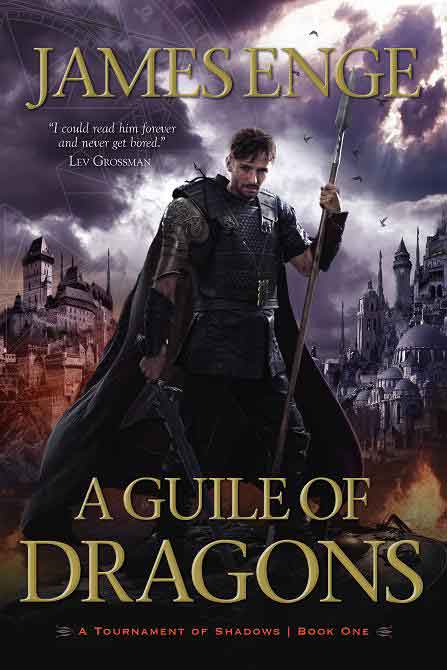
A Guile of Dragons : A Tournament of Shadows Book 1 by James Enge (2012)

A Guile of Dragons marks James Enge’s fourth novel featuring the ever more popular character Morlock Ambrosius. Those familiar with Enge’s work, through the previous novels (Blood of Ambrose 2009 (nominated for Best Fantasy Book of the Year), This Crooked Way 2009 (an episodic narrative of linked short stories), and The Wolf Age 2010) or his short fiction in Black Gate magazine (BG14, 12, 11, 10, 9 & 8) or the Swords & Dark Magic (Harper Voyager, 2010) anthology may remember Morlock as the crotchety alcoholic, sword swinging, master maker (wizard). However, Guile is a prequel to the established novels and shorts and is part of Morlock’s origin story.

James Enge sets himself a doubly hard task in A Guile of Dragons. Firstly, it is book one of a trilogy, and, secondly, it is a prequel. Both present distinct challenges. Book ones need to capture attention, give the reader something to engage the imagination and stimulate interest, and provide narrative satisfaction while still leaving something for the rest of the series to develop. This is not easy at the best of times. Prequels also have a few paradoxical conditions all of their own. Fans of the previous books want to delve deeper into a character’s past and backstory, while at the same time see hints and foreshadowing of later events, rewarding their loyalty and knowledge of the series. Narrative tension is harder to maintain when the reader already knows that there is a distinct lack of peril. The story and world must be accessible to new readers but also not bore fans of the earlier works who already know and understand the world and characters. It is therefore a testament to his growing prowess as an author that Enge walks this fine line almost effortlessly.

Enge’s development as a writer can also be seen in how he has moved his story away from its stereotypical mythic roots. As the continuation of a world and series, Enge can’t quite escape the Arthurian influences and connections in his earlier Morlock stories, nor the resemblance to the world construction and cosmology of Zelazny’s Amber, but in Guile, as in The Wolf Age, he has managed to create something that seems much more his own voice and vision. The world of Guile possesses an individual quality and originality that is somewhat missing from many of Enge’s previous narratives too heavily derived from earlier sources. So while Merlin is still Morlock’s father, and some Arthurian elements and aspects remain, he manages to evoke an engaging world that stands on its own as a fantasy creation and setting. What is more impressive is that his short story writing has honed his ability to conjure detailed worlds, characters and societies without resorting to bald exposition and overly long descriptions.

While the Werewolf city of Wuruyaaria formed the central locale in the last book, the majority of the action in Guile occurs in and around the Dwarven nation of Thrymhaiam. As a nation and a race, Enge has given the Dwarves distinct characteristics and characterisations removed from that of Tolkien’s defining creation or even Markus Heitz’s updated version. Unlike previous authors’ attempts to reinvent an established fantasy race, Enge actually succeeds in making the Dwarves both recognisable in their Dwarvishness and yet feel fresh and naturally developed. Their love of mining and gems is explained simply and yet effectively. Their gruff manner seems natural and understandable given their code of honour and intractable devotion to family and clan. These core aspects of fantasy Dwarves are made to feel simple, straightforward and, paradoxically, original. A revelation toward the end of the novel cements this vision of the Dwarves as unique and provides a wonderful rationale and explanation of their entire world view.

In The Wolf Age, a major strength of Enge’s approach was to design a unique language and culture for the werewolves utilising his academic expertise for exploring and explaining ancient languages and cultures and combined it with his storytelling and inventiveness. A disadvantage to this was that while it was consistent, logical and fascinating, the lupine language was exceptionally difficult to read leading to a frustrating experience trying to understand and articulate character names. The language made logical sense and was a brilliant stroke, but visually (and indeed aurally) it was a major stumbling block for those without his background in classics and ancient history (or an inability to mimic wolf sounds). This has been substantially redressed in Guile. The same attention to detail and creative talent has been utilised to give the Dwarven language and culture an authenticity that hasn’t been seen since Tolkien, but he has taken pity on his reader and minimised the use of the specific language constructs. The Dwarven names are relatively short yet, despite the rare outright appearance of the Dwarvish tongue, this depth of design permeates the entire culture. From subtle nuances such as the method for navigating the deep mines (thankfully not relying on a special power or Dwarvish ability) to more overt cultural aspects such as the clan hierarchy emphasising blood kinship there is both a consistency and originality to the Dwarven race.

As an origin story, the reader becomes privy to the mystical events that lead to the strange and mysterious birth of Morlock. The result of which is that the young baby Morlock is fostered by the ruler of the Dwarves. Understandably this leads to some resentment of not only his birth parents, of whom he is ashamed and resents, but more subtly of his adopted ‘race’ due to his feelings of alienation and difference. Given how this character has been represented later in his life in the other stories, this psychological development and scarring sow the seeds for Morlock’s later dysfunctions and ‘outsider’ status. Yet Enge cleverly weaves this overt character origin story with an exploration of the origins of the Dwarvish race. As the story progresses the reader follows Morlock as he slowly uncovers aspects of his personal history as well as that of his adoptive family. The blending of the two plot lines in this thematic fashion, melding Morlock’s feelings of abandonment and betrayal on both a personal and racial level, adds depth to the narrative and provides a conceptual theme that links the various story elements neatly and effectively. In particular, the leitmotif of betrayal forms a consistent touchstone that Enge returns to again and again to great effect. This combination of recurrent theme and concept permeates the entire narrative providing an effective consistency to the narrative without being heavy handed. Indeed there are very few elements of the story that feel disparate or unconnected which can be a problem in long fiction written by short fiction authors.

As with previous work, Enge does not focus solely on Morlock’s perspective, allowing the reader to view the character from external subjective perspectives. This subtle reframing of the narrative focus encourages reader engagement with other characters, the prejudices and problems of the various cultures and societies, and adds to the sense of verisimilitude of the fantasyland. An additional benefit is that Morlock retains his mystery and mystique as the narration does not delve too deeply into his thoughts and opinions but gives just enough to emphasise Morlock’s point of view and his status as the central character. However, this leads to a discussion of some of the, albeit minor, weaknesses of Guile.

The secondary character of Earno, while initially an important and thought-provoking character perspective, is dropped almost entirely from the narrative at a certain point for little discernible reason. The inclusion of further secondary Graith characters Aloê, Naevros, Noreê, Illion, and Jordel also seems forced and arbitrary. No doubt this signals their importance for later development in the subsequent sequels, and Enge probably wanted to familiarise his readers with them, but ultimately they feel unnecessary and distract from the main thrust of the novel. Another character that doesn’t quite live up to Enge’s originality is the pater familias of the Dwarven clan, Thyr. While a likable and interesting character, a gruff Dwarven king, who is honourable and has a deeply affectionate side, and who also acts as a surrogate father to the hero, Thyr could have stepped straight from the pages of fantasy cliché. Weis and Hickman’s Flint Fireforge from their Dragonlance series, or R.A. Salvatore’s Bruenor Battlehammer from his Forgotten Realms novels, are equally representative of this cliché, but given Enge’s originality in almost every other aspect of this novel, it seems worse that he fell back on this overused trope.

The most disappointing aspect of Guile may also be one of its strongest selling points for other readers. There is a distinct lack of epic action. The majority of the novel focuses on lesser moments of action, when they are included at all, and Enge prefers to explore the build-up to and aftermath of battles and fights from a personal and individual narrative perspective. By keeping the focus so close to a single character in these sequences there is no real overview of the vast, epic nature of the conflicts, and some of the most important action sequences happen off page. As a result, while the story features dragons and undead warrior kings (definitely not barrowwights… well ok so there are still some elements of Tolkien that Enge ‘borrows’), the conflicts feel small and underdeveloped despite their epic ramifications and the scale of the threat. This leads to the dramatic ending of Guile feeling underwhelming and dissatisfying.

On the whole, the strengths of A Guile of Dragons outweigh the minor plotting weaknesses, and the lack of overt epic action is as much a stylistic choice and strength as it is a weakness. James Enge delivers a fascinating and original perspective on Dwarves and has successfully crafted an engaging and entertaining origin story for his signature character, Morlock Ambrosius. This book promises great things for the rest of the trilogy and the continuing development of Enge’s fantasy setting.

(Originally reviewed in Vector)

Do Chainmail Chicks Suffer From A Glass Ceiling? Just Desserts or Just Desserts for the heroines of fantasy?

Leelee Sobieski as Joan of Arc

Unfortunately the title is much catchier than the paper itself, but I am playing on the preconceived notions about women in fantasy.  We are all too aware of the so called women’s roles in fantasy; the love interest, the witch, the femme fatale or temptress, the lonely warrior maiden, the ice queen etc. etc.  We are also aware of the usual female versions of the traditional male fantasy roles; huntress instead of hunter, princess instead of prince, sorceress instead of sorcerer, enchantress instead of enchanter, warrior maiden instead of warrior, assassiness instead of assassin… well the last two don’t actually fit, but it is interesting to note that it appears you can’t be a female warrior if you are married and have kids.  Apparently there are a few gendered roles and then some non-specific genderless ones that can be performed by either sex equally well.  Assassin, thief, spy are all exceptions to the male/female dichotomy and yet all are morally ambiguous characters who may or may not be heroes and all prize stealth and agility over physical strength.

Even the term ‘heroine’ is problematic in this sense as it appears as inferior or lesser than the assumed male ‘hero’.  It conjures up images of damsels in distress, princesses needing rescuing by the big strapping young farm boy who is also secretly a long lost king.  So perhaps I should instead be speaking about female heroes rather than heroines.  Certainly my intention is to discuss female protagonists and female characters that are central or integral to the plot and additionally are on the side of good rather than evil which is a whole other paper entirely.

As I said earlier this is part of my on going research about the representations of gender in genre fantasy and in part I owe a great deal of the paper to Sylvia Kelso’s article in the New York Review of Science Fiction entitled The King and the Enchanter.[1]  In this she addresses the problem of the powerful magic users of fantasy who seem to go out of their way to find the missing progeny of Kings and train them to assume the throne, and asks the question why don’t the mages do it themselves?

Part of her discussion deals with the role of the king and of kingship in fantasy and links it to the idea of hegemonic masculinity which she suggests is the norm in genre fantasy.

To quote her here “[…] this norm emerges most clearly through the numerous stories of male protagonists who learn to become king […] a fantasy king must learn to restrain heroic, individual violence, accept counsel, and avoid tyranny […] once crowned, the good king marries and sires an heir.” P.1

But during her article she also mentions a few characters as examples of this argument and the short shrift they receive in terms of fantasy rewards for their actions.  In particular her discussion of the female enchantress characters stood out for me and started me thinking about the rewards of all female heroes in fantasy, not just the enchantresses.

To begin with I want to lay out very briefly a sort of reductionist hero template for you.  Let us take the standard fantasy hero.  When constructing a hero is there a physical template that we adhere to when we think of how they appear? It seems that the ‘standard hero’ at least until the last few years, has been a blonde, blue eyed, white, Anglo Germanic male.  We even presume that the hero is a male.

When we think of the trials of the hero the most obvious adventures are those of monster slaying, a quest to find a magical object and fighting some great big evil.

In terms of the rewards that a hero receives at the end of the tale we expect him to be rewarded with a throne or position of nobility of some kind, a bride (usually a princess) and a magical item, which in most cases is a sword.

Now I realise that there are more than a few genre fantasy texts that do not conform to this template.  As I said it is a reductionist point of view and as such not entirely accurate.  However, there are enough fantasy books out there that conform to this set to hopefully make it recognisable.  I think most people here can see this as roughly representative of a stereotypical heroic format.

Now taking this as a model lets see if we can apply it equally well to the female characters and female heroes of fantasy.

Physical description:  What do female heroes look like? Well in terms of actual physicality there isn’t a lot of consensus, certainly we have Wynne Jones’ Tough Guide to Fantasyland which highlights many of the stereotypes being used, but there isn’t really a physical template for a female hero unless we take into account slightly non-specific or aesthetic attributes like beauty, athleticism, ravishing eyes, fiery temper, and porcelain skin.  But at this juncture we could easily list far more texts that do not conform to this than we could do with the male template.  It just seems to be that there is a stereotypical physicality to the male hero that isn’t present in female heroes, they tend toward stereotypical emotional and aesthetic traits rather than physical.

Trials of the heroine: If we have a female hero does she undergo the same trials as the male hero?  In my opinion you don’t have the same degree of standard trials, there doesn’t appear to be a template for the trials that a female hero goes through.

Now on this point I think you have to make a distinction between the structural narratological perspective provided by a Proppian analysis, which could quite easily point out various connections between donor functions, complicity, violation and interdiction and so on.  I am not arguing that the trials of the female hero provide different narratological meanings, simply that in terms of plot they are different trials.

For a start one of the major differences is that female heroes, certainly in recent genre fantasy, seem to undergo some form of sexual abuse which is rare in cases of a male hero.  In Hobb’s Liveship series, two of the central female characters suffer various levels of sexual abuse, including rape, in Feist and Wurts’ Empire Trilogy Mara of the Acoma is physically and sexually abused by her husband and threatened with rape repeatedly by various villains, and even in Eddings’ Belgariad, a favourite of young readers, we encounter the character of Taiba, who suffered rape, sexual abuse and violent attacks in the slave pits.

And in terms of monster slaying it is rare that the a female hero is sent out to do this, so my basic point is that yes there just as many trials to test the female hero, but in terms of event, they generally appear as distinct and specific to the heroine, rather than the generic male events.

Quest Rewards: So finally we get to the area that I really want to discuss.

Again, the standard quest rewards for male heroes does not seem to translate directly to female heroes.  When we think of the male quest rewards it was fairly easy to think of the standard responses, the bride, the throne, the sword.  But it is much more difficult to think of similar rewards for female heroes.

But there is a curious recurrence of fantasy rewards for these female protagonists.

At the end of the quest or adventure the female hero can expect one of or a combination of the following:

  1. Love
  2. Marriage
  3. Domestic Harmony
  4. Children
  5. Retirement from adventuring.

Ultimately these are usually combined into one overwhelming principle:

  1. A good man to look after her and treat her right.

Am I overstating the case here?  To illustrate this point I am going to relay some examples but as I do so I want you to consider two questions.  The first “Are the following rewards for the female hero appropriate?” and the second “Should the rewards for a female hero be the same as those of the male?”.

Ok then, the case studies or more accurately some examples.

Polgara the Sorceress

Polgara is one of the main characters of several of David (and Leigh) Eddings’ books.  She appears in the Belgariad series, the Mallorean, Belgarath the Sorcerer and of course her own title, Polgara the Sorceress.

So a little about her then.  In terms of physicality she is beautiful, although her beauty is often termed as regal or proud, so we know she is not drop dead gorgeous but has a stately grace.  She has dark hair, so dark it is almost black and a near luminous white lock at the front.  She is over three thousand years old and is also a twin.  Her twin sister, Beldaran, is described as effortlessly beautiful, blonde, blue eyed, gentle, caring and loving, and who was given as a bride to a young noble who had completed an epic quest.  Polgara wasn’t.

Of her sister the character of Polgara says, “She was to be the vessel of love; I was to be the vessel of power!”

During the course of the Belgariad Polgara is an enormously important character, she has acted as surrogate mother to the hero, she has protected him and his ancestors for much of her greatly extended life (although her exploits read as a litany of failures) and on the quest she wields great magical power and deals with the semi-evil priestess Salmissra so that the men don’t have to fight a woman.

However Polgara’s role in the ultimate confrontation between the evil god Torak and the young hero Garion is as follows.  She has to refuse to be the evil god’s bride.

The wisest, oldest, most powerful woman in the world aids in the fight against evil by refusing to marry.  She has been reduced to a prize to be fought over.

Not only that, the only reason she is able to find the strength to resist Torak is because Durnik, whom she has realised is her one true love, has just died and it is the anguish and pain caused by this loss that sustains her and she has to be reminded of this by the central hero Garion.

So what is her reward?

For refusing Torak’s proposal Polgara is given a husband and the chance to raise a family of her own.  She retires with her husband to a small cottage in the country where she looks after a young foundling and eventually gives birth to twins of her own.  In some respects this is a just reward, she has spent the greater part of her life guiding and protecting other people’s children and families and now has the chance to have her own now that her ‘job’ is done.  However, a duchess of immeasurable power and influence, regal beyond the ken of normal humans, has just been consigned to a small cottage in the middle of nowhere so she can raise rug rats.  Is this really the proper reward for thousands of years of service and sacrifice?

In comparison Durnik, Polgara’s husband, seems to do a little better out of the deal.  Not only is he resurrected gaining a new lease of life, pardon the pun, he has been given magical powers comparable to hers.  So his reward for participating in the quest is having his lifespan extended to match hers, magical powers that match hers that he learns to use in a matter of days rather than the centuries it took her to acquire them, a powerful beautiful wife and ultimately children.  He gets the traditional male quest rewards whilst she is left being his prize.

Ce’Nedra

Ce’Nedra is another example from Eddings’ fantasy world.  Throughout the first series she is a childish, spoiled foil to the young hero Garion.  Her contribution to the quest, in addition to being the love interest for the hero, is to raise an army to distract the forces of evil a la Tolkien.  However she raises the army in Garion’s name and it is his power that she is wielding rather than her own.  She does not command the army in so much as she is a figurehead for the army to rally around.  Her reward for the quest is to be Garion’s bride.  True she gains a kingdom and a marital partner much like the traditional male hero and he generously deigns to give her co-rulership over his domain, yet he retains the title of Overlord of the West whilst she remains his queen and so he is still politically her superior.  She also is promised the birth of a son to be the new heir to the restored throne, before she can have any female children.

So again the female reward is actually to be the reward for the male hero.  Garion in this case gains a bride, a son, a throne and a magical sword.

Mara

Mara of the Acoma is an interesting case.

In Feist and Wurts’ trilogy set during and after Feist’s Riftwar trilogy, we are introduced to a fascinating female character.  Mara of the Acoma.  She is a young girl about to take religious orders and effectively become a nun when she is rushed home to assume the mantle of rulership over her house/family. Although not a standard quest narrative Mara has to undergo several adventures and political machinations to strengthen her weakened political position.  Like many female heroes she is a woman fighting to survive in a male arena.

She uses sex, manipulation and astute planning in addition to a great deal of luck and sacrifice to win out over her rivals.

She sacrifices love, relationships and integrity to ultimately bring peace to the land, a stable  ruler to the throne, remove the absolute power wielded by the male cadre of magicians, frees women to study magic, and helps improve relations with the Kingdom across the rift.

Ultimately her sacrifice puts her son on the throne of the empire and she achieves power and respect.  She has protected her house, restored the honour of her ancestors and forgone individual advancement for the greater good.  A self sacrificing hero.  She becomes the ultimate power behind the throne.

However her true reward at the end of the third book is when the long lost barbarian love of her life returns to claim his place as her lover and father to their child.  She throws off the reserve of her people, defies tradition and is brought true happiness in this love match.

So lets look at these rewards, it is her son that becomes emperor not her.  And in terms of Kevin, the ex-slave, he has been given a male heir who is the ruler of the most powerful land on two planets, the love of a beautiful and powerful woman, a noble title and lands.  Once again the males seem to get everything whilst Mara gets to have domestic bliss.

My last example is that of Hobb’s Althea Vistrit.  One of the central characters of The Liveship Trilogy, and initially framed as the central protagonist.  Althea sets out at the beginning of the series to become a good sailor worthy of captaining the family Liveship, the Vivacia.  She disguises her gender in order to sign on as an anonymous sailor and receive the training and experience she needs, during the course of which she also becomes an expert at skinning animals.  This basic training in the general skills of a common sailor, combined with her navigational skills and command experience gathered whilst being on board as the Captain’s daughter make Althea an excellent all round sailor and a potentially great captain.

However by the end of the book, she forgoes control of the family liveship and ends up being promised marriage by the love of her life who is now the captain of his own liveship.  She ultimately sacrifices her own goals to be his wife and first mate aboard his ship.

At the same time her nephew, Wintrow, who throughout the books has disavowed a life on the sea, is granted control of the family liveship, is to be surrogate father to the future king of the pirate isles and ultimately marry the king’s mother.  He is rewarded in a slightly roundabout way with a throne, a child, a bride and a magical item in true heroic fashion.

So can we see female heroes as recipients of rewards or are they always the prize?  The fantasy genre seems to lean towards a patriarchal bias and the style of writing lends itself to male gendered stories and until this changes I fear that women will always suffer from a glass ceiling in fantasy land.

[1] The Kelso article is “The King and the Enchanter: gender, power and authority in Patricia McKillip’s fantasy Novel”.  Kelso, Sylvia The New York Review of Science Fiction No.210 (Feb 2006) p.1, 8-12

(Originally presented as a paper at ICFA28)

Review: Forge of Darkness by Steven Erikson

ForgeofDarkness-sm

Forge of Darkness: The Kharkanas Trilogy 1  by Steven Erikson

Forge of Darkness is the first book in a new trilogy by Steven Erikson. While linked to the world and events of his ten book epic fantasy series The Malazan Book of the Fallen (MBotF), the Kharkanas trilogy is a prequel to those events and is set millennia earlier, in a different land and it explores the mythic prehistory of the enigmatic Tiste race. The story focuses on a turning point in the history of the Tiste, focalised in the city of Kharkanas, the home of the queen and newly styled goddess, Mother Dark. Tensions have developed in the court due to a classic love triangle developing between Mother Dark, her acknowledged consort, the mysterious Lord Draconus, and her politically pragmatic betrothal to Lord Vatha Urusander, former commander of the Legions. Added to this charged situation are the various groups of disenfranchised and ill-treated soldiers of the various armed forces and House guards, each pledged to a specific faction, and the ever present machinations of a powerful, elite and decadent noble class. The blend of political manoeuvrings, a civilisation in decline, the emergence of a new religion and of wide-spread social unrest creates a classic framework for the interweaving of the personal narratives of key players, their supporters and the innocent bystanders drawn in against their will. This story of politics and the collapse of a civilisation is played out against a metaphysical backdrop of realms of magic and Gods that are being forced to change and alter as the destiny of the world reshapes itself. That Erikson never lets the story become overly complicated or convoluted is again evidence of his mastery of this style of writing.

The tone of Forge is strongly reminiscent of Shakespeare, as are elements of the plot and the structure of the story. At times even the dialogue takes on a courtly Elizabethan feel. Yet this does not feel out of place in a Fantasy novel involving courtly politics and the stirrings of war. In fact it adds to the classical style of the novel and the writing itself remains recognisable as Erikson. He continues to write with the weight and layering of a complex short story and almost none of the expositionary excess verbiage commonly associated with fat Fantasy tomes. His language remains deft, economical and rewards careful reading (and re-reading). The structure of multiple and apparently disparate narrative threads which slowly interweave into a narrative confluence and convergence will be immediately recognisable to fans of the earlier series, although as a Book One, not all threads are fully resolved within the novel and plenty has been left for further development. It should be noted that there is plenty of closure within the novel and several sequences in key places provide excellent reader satisfaction. But where many of the books of the MBotF were written as stand-alone novels set in a broader series, Forge is definitely part of what has become a traditional trilogy format in Fantasy storytelling.

As a prequel to the MBotF, in so much as it occurs millennia before the events of those novels, Forge functions as an accessible entry point for new readers, perhaps more so than Gardens of the Moon (the first book in the MBotF). While there is certainly a large cast of point of view characters and participants, this seems less overwhelming in Forge than it did in Gardens and will perhaps prove less daunting to an audience who have been familiarised with this style by George R. R. Martin’s popular series A Song of Ice and Fire (and of course the HBO adaptation A Game of Thrones). Although, in the interests of full disclosure, being familiar with the MBotF may have simply blinded me to some of the challenges faced by new readers. There is, however, a sense that Erikson has streamlined this narrative slightly and has taken some pity on his readers, a result of which is the fact that the story begins at an understandable point of entry rather than right in the middle of a complex conflict, and each of the major figures and focal characters are slowly introduced in sections rather than in a headlong whirl of narrative action. In some respects Forge represents a much more traditional structure, tone and narrative focus than previous Malazan novels, but has done so without compromising the integrity and style that Erikson has developed over the last decade of writing.

Erikson again utilises a tight narrative focalisation through the use of multiple character perspectives to negotiate not only the different story threads but also to reveal a cross section of perspective on the mounting tensions and social unrest. His use of key characters, noble and commoner alike, powerful and powerless, gives a palpable sense of verisimilitude and believability to the world in order to balance the epic and mythic nature of the story. This is not just a story of the great and the good or a band of do-gooding nobles on a quest, but a story concerned with the fabric of a society seen from each of the different factions and levels. As a result, despite many of the metaphysical elements and strange magical constructions, this world feels real. Erikson’s novel creates moral complexity and narrative tensions by narrating the evolving conflict from diverse character perspectives. This both grounds the diegetic reality in distressed and worn realism as well as presenting the metaphysical magically aspects as matter-of-fact and part of the very fabric of reality. As the reader follows the lives of those drawn into this conflict, either at its centre or initially on its fringes, there is never a sense of forced or dictated narrative but rather a sense of exploration and witnessing of a true world event as complex and as complicated as our own.

The strong sense of social inequality and regimented class system of the Tiste could be attributed to Erikson’s time in the UK over the last few years and the British preoccupation with class and hierarchy, but this would be to ignore the applicability of the conceptual stratification to social, economic and racial divides present throughout our modern world. Given that the various conflicts and tensions within the text are predicated on characters acting through either personal agendas or for what they believe is a greater good, there is ample room in Forge to read modern political and economic debates as an analogue of these conflicts. But there is also a strong evocation of the politics and history of Julius Caesar’s Rome. This could perhaps be laid at the feet of Erikson the former archaeologist and anthropologist and his view of the circular nature of history, and the mistakes we are doomed to repeat. Yet this classical connection to Ancient Rome, coupled with the Shakespearean feel and tone signals Forge’s nature as a tragedy, rather than an epic Fantasy romp. So without resorting to stealing a classical setting or specifics from world history Erikson evokes both Greek tragedy and Roman history in this expanding of the mythic backstory. The focus on the leading patrician families, those recently elevated as well as those in decline, in addition to commoners who could unkindly be labelled Rude Mechanicals, certainly adds to the feeling of Classical history being told through a Shakespearean lens. While the by-play of economics, inherited power, political polemic and the treatment of the military as a central theme to the story not only suggests an Ancient Roman influence on the narrative, but also strikes a resonant chord with today’s world. An apt comparison to a modern example would be HBO’s and BBC’s short-lived series Rome which explored the historical narrative through both noble powerbrokers and common soldiers, giving a sense of both the domestic and political world of Ancient Rome, a sense of the epic and the mundane.

The Malazan series is known for its complex morality and lack of clear cut heroes and villains, and a strength of Forge is that it exhibits much of this same moral ambiguity. Every character in the novel feels rounded and developed over time, yet no character is a paragon of virtue or grotesquely evil. The strengths and flaws of each character, coupled with their subjective perspective, personal goals and ambitions, leads to deeply intriguing characters whom the reader is free to like or dislike. Although, as is customary in Erikson’s writing, readers should be prepared to have their opinions of characters challenged on a regular basis. The movement in modern Genre Fantasy toward moral complexity has on occasion been confused with Nihilism, for example in Leo Grin’s articles on Big Hollywood. In some respects Grin is not wholly wrong. There has certainly been a significant move toward increasing numbers of violent psychopathic protagonists, yet unlike many of the ‘gritty’ modern genre fantasy stories, for example Joe Abercrombie’s First Law Trilogy, Erikson does not create dark anti-heroes or malevolent, Machiavellian misanthropes in an effort to make the story darker and more gripping, rather he relies on the moments when characters’ actions create genuine moments of horror, pain or, most often, tragedy. There is no cackling Dark Lord or supernaturally diabolical destructive force behind the action, only people. His fiction focuses on those moments and decisions, seemingly big or small, which, with hindsight, we can see led us on a path of inevitable destruction. As a misspoken command can turn the tide of a battle, or the wrong word at the wrong time can lead to war, Erikson feels no need to invent a devilish villain to create narrative tension. This gives much of the tragic air to Erikson’s writing as the reader witnesses how miscommunication, pride, honour, love and duty collide in an inevitable catastrophic confluence which reshapes the world irrevocably. While some of the characters appear motivated by personal ambition and damn the consequences, others are forced into action as the circumstances dictate, and yet all have understandable, if not always agreeable, motivations. The tight narrative focus on character perspective means that the reader is often faced with a series of actions that they completely agree with, only to have their judgement challenged when the story shifts to the perspective of another faction or character.

Erikson pulls as few emotional punches in his writing as he does intellectual, instead he tends to face emotional and brutal truths of the human condition face on. Forge is no exception in this regard. One scene in particular is particularly distressing and harrowing. Yet Erikson’s depiction of a brutal gang rape and murder is never salacious, never misogynist and never a glorification of rape. He does not sexualise or fetishize one of the most deplorable acts of violence humans are capable of and as a result the scene is disturbing and violent in a way that Fantasy fiction rarely details. That the scene was necessary for the narrative may be a cause of debate among some, others will feel outrage at its inclusion, so those expecting a consolatory tour through fantasyland may wish to look elsewhere. One thing is certain though, those Fantasy readers accustomed to casual sexual violence against women as entertainment will have their perspective radically challenged and will be forced to rethink think the easy way rape is often portrayed in the genre. Yet Erikson’s works have never flinched in challenging readers to confront hard issues. His work is characterised by its complex nature and one of the great strengths of his writing is his ability to challenge reader expectation and complacency. There are no simple answers in Erikson’s world, only the heart rending tragedy of honest, flawed individuals being caught up in a world descending into chaos, victims and perpetrators alike. Again, his use of shifting points of view makes the reader view these uncomfortable truths from multiple perspectives providing insight into aspects of the human condition that we might not otherwise consider.

The world building retains Erikson’s strength of vision and presence, yet the physical locale seems more metaphysical, closer to a mindscape linked to the characters than a geographically fixed mundane world. This mixture of a solid world locale and a more nebulous Faerie realm marks a slight departure from the MBotF which was firmly rooted in a defined reality. An apt parallel might be to describe it as similar to mythic Olympus as it is connected to the concrete landscape of Greece. As the various travellers cross the Realm the reader is exposed to shifting boundaries of a truly mythic land with areas of fixed solidity. Akin to Glen Cook’s Black Company series, the world building of Forge remains thoughtful, detailed and intricately rendered, while at the same time never feeling forced, laboured or overly emphasised. In essence it is a well-crafted world with enough information to fill the mind but not belabouring detail and exposition.

While much of the new book will prove to be a good entry point for new readers, fans of the MBotF will not be disappointed. The prehistory features several of the key characters introduced in the first series who have long remained enigmatic and whose history has been both mysteriously alluded to and yet never fully known. There are a number of ‘reveals’ about key events in this mythic past that shaped the characters that fans have come to know and demand more detail of. In particular, the history and story of Anomander Rake and his brothers Andarist and Silchas Ruin forms one of the central threads of the narrative tapestry in Forge and is a key focal point of the trilogy. An interesting side effect of this strategy of focusing on the familial dimension to a civil conflict is that it not only rewards fans of the previous series, but it also emphasises the import and severity of a civil conflict and how it can pit brother against brother. As expected, characters such as the oft referred to Mother Dark and the enigmatic Draconus feature heavily. Yet Erikson resists the temptation to dictate to his readers and usually presents these figures from the perspective of external witnesses to their actions rather than narrating from their point of view. This discipline serves the dual function of sating fan interest in the history of these key mythic figures while still allowing some mystery and enigma to survive. So while readers new to the Malazan series are given plenty of help to negotiate the story (the lack of which is often a criticism levelled at Erikson’s first Malazan novel Gardens of the Moon) this does not result in pedantic exposition that will alienate fans. Indeed those fans of the series will have a great many questions answered, but as has become a feature of Erikson’s writing, those answers are not necessarily the expected ones and often lead to further questions. But the investigation of Tiste culture, the exploration of Kharkanas and the surrounding environs as well as a more detailed examination of the legendary hust swords are more than enough to sate fans of the series.

Something to note about the narrative frame of Forge is that Erikson has styled this as the telling of the story between one legendary master poet, Blind Gallan, to a younger poet, Fisher kel Tath, who will be a familiar character to fans of the series. In part this returns to part of the focus of Erikson’s novella Crack’d Pot Trail which concerned the nature of storytelling, but it may in fact be a simple defence to forestall criticism that he has altered some of the facts alluded to in the main series. Fans of Erikson’s works are used to the cry of ‘the timeline doesn’t matter’ and in this instance Erikson has the poet admit that he has changed some of the story to fit his poetic sensibilities, ‘what I do not recall I shall invent’(‘Prelude’ 1st page 4th paragraph). However, to simply label it as this would be a disservice to Erikson as this framework fits neatly with the feel of epic tragedy, the Shakesperean tone and the subject matter of the fall of a civilisation. It is also a recognition of the genre’s debt to and evolution from the great epic poems of the past.

For those who have found the length of the Malazan Book of the Fallen to be a daunting barrier to experiencing Erikson’s writing, and those who could not navigate through Gardens of the Moon, Forge of Darkness provides the perfect opportunity to access the work of a unique voice in Fantasy that has grown and developed to true mastery. For fans and new readers alike, Forge is a study in how original, intelligent and astonishing a work of Epic Fantasy can be.

(originally reviewed in NYRSF)

A Response to George R.R. Martin’s Interview

George-RR-Martin-thumb

Earlier this year, in an article on Entertainment Weekly George R.R. Martin explains why there is violence against women in his series A Song of Ice and Fire.

From the outset I want to make it very, very clear that George R.R. Martin, as with any author, is perfectly entitled to do whatever he wants in his world, to and with his characters and has no need to justify those reasons to me.  I was a fan of the first few books in the series, and I am all for greater numbers of fantasy books and TV shows being created.  This discussion is about the article and the arguments he makes justifying the depiction of rape and sexual violence against women in his novels.

George R.R. Martin offers three interlinked explanations as to why there is so much rape and sexual violence against women in his novels.  Given the amount of ink spilled on the sexual violence in his novels and in the TV Show adaptation it is understandable that his explanations are more akin to defences to charges.  So what are his points?

Defence 1: Temporal Realism – The books are a reflection of Medieval society therefore the depiction of sexual violence against women is justified on the basis it happened in the Middle Ages.
“The books reflect a patriarchal society based on the Middle Ages. The Middle Ages were not a time of sexual egalitarianism. It was very classist, dividing people into three classes. And they had strong ideas about the roles of women.” – Martin

Defence 2 : Balancing Realism and Fantasy – Although it is a fantasy you can’t change everything.
“If you’re going to do [a fantasy element], it’s best to only do one of them, or a few. I wanted my books to be strongly grounded in history and to show what medieval society was like, and I was also reacting to a lot of fantasy fiction. Most stories depict what I call the ‘Disneyland Middle Ages’—there are princes and princesses and knights in shining armor, but they didn’t want to show what those societies meant and how they functioned.” – Martin

Defence 3 : Realism of the Human Condition – Rape and sexual violence is the dark underbelly of the human condition and it would be dishonest to pretend it doesn’t exist.
“I’m writing about war, which what almost all epic fantasy is about. But if you’re going to write about war, and you just want to include all the cool battles and heroes killing a lot of orcs and things like that and you don’t portray [sexual violence], then there’s something fundamentally dishonest about that. Rape, unfortunately, is still a part of war today. It’s not a strong testament to the human race, but I don’t think we should pretend it doesn’t exist.” – Martin

With all due respect to Mr Martin I don’t think these are persuasive arguments and I am going to explain why.

Before I get started, here is a great article (and this one) that breaks down the incidents of rape and sexual violence in the book series as well as the TV show so we know what we are talking about.

To summarise:

Rape acts in ASOIAF the book series (to date): 214

Rape victims in ASOIAF (to date): 117

With the exception of Maester Kerwin who was gang raped, and the victims of Septon Utt (young boys he raped and murdered), all the other rapes are performed on women. All of them.  That is over 200 acts of rape and sexual violence against women mentioned or depicted in the novels, and just over 10 are depicted or mentioned in regard to sexual violence and rape of men and boys.  Just let that sink in for a moment.  Less than 5% of the sexual violence of the world of A Song of Ice and Fire is perpetrated against men.

So how does this relate to Martin’s defences?  If Martin wants to make the argument that his world building is gritty and realistic and follows a more believable pattern of the medieval time period then he has some very skewed perceptions about rape and sexual violence.

A simple example that exposes this bias and skewed thinking can be found in the institution of the Night’s Watch.  He populates the Night’s Watch with murderers, rapists, thieves, and the cast-offs of society, sends them up to the middle of nowhere, prevents them from mixing with anyone else, denies them access to a civilian population with which to fraternise, and yet they never indulge in the rape or sexual assault of the newcomers to the Watch.

They might hate each other, want to kill each other, scheme against one another, but certainly not rape each other. Because we all know that rape never happened in the military, never happened in prisons, and certainly wouldn’t happen in a quasi-military force made up of criminals locked away from the rest of humanity.

Therefore Martin’s work suggests that it is more believable that an army of men, made up of the dregs of humanity, kept in close ranks and away from any other distractions, don’t indulge in rape, whereas the rape of noblewomen, protected female wards and commoners alike is commonplace.

So even if Martin’s aim is to have represented a brutal reality of a harsh and unforgiving medieval-esque world, there is a strong authorial bias toward sexual violence against women that far outweighs and overshadows any of the sexual violence against men.  Given that there is a substantial body of literature and scholarship on pederasty, sodomy, lechery, paedophilia and male rape in the Medieval time period and earlier, it is clear that Martin’s choice to focus on sexual violence against women is clearly that; an authorial choice.  Male rape did exist.  Male rape was common enough throughout history to have numerous mentions and strictures in religious texts, laws and customs throughout the world.  If Martin is going to use historical veracity as a defence he has chosen a strangely biased form of that veracity to depict in his novels.

By his own argument then, to depict a realistic version of Medieval society warts and all, Martin has failed in his worldbuilding.

But Martin then argues that this is only a Medieval-esque world, that one can only change so much.  So perhaps excluding male rape is one change too many for him.  This leads us to the discussion of his assertion that you can only change certain things.

I would fundamentally disagree with this premise, and also disagree with the argument that to include an element of gender equality would produce boring results.  Steven Erikson’s Malazan Book of the Fallen is just as epic, gritty, detailed, and hard hitting as Martin’s ASoIaF, yet it manages to be so despite the fact that there is gender and sexual equality.  Erikson has written a fantasy world with tension, drama, and tragedy without using rape as a quick plot device to provide flavour to the actions of male characters or making it a boring feminist utopia in the way that Martin assumes such writing must be.  Erikson has women serving openly in the military, leading countries, being generals, assassins, mages, heavy infantry and so on and so forth.  Yet no one has ever accused his writing of being a boring utopia without drama.

Martin is a professional and successful author, and he knows that there are innumerable ways to create drama and tension in fiction without resorting to sexual violence against women.  He is also well read enough to know of, if not to have read, several of the great Feminist Science fiction novels by authors such as Ursula Le Guin, Joanna Russ and Marge Piercy (to name but a few), who wrote about feminist societies and gender equal societies without creating ‘a pretty boring book’.  So it is more than a little disingenuous to claim that he needed sexual violence in order to create drama.

But his third defence is perhaps the most troubling of his reasoning here as not only does it damn him in his choice to depict so much female rape and so little male rape, but it also undercuts his argument that you can only change a few things in fantasy.  He claims that he is attempting to show the dark side of the human condition, that to deny that rape happens in war is ‘fundamentally dishonest’.  So is it fundamentally dishonest of him to not depict the horrors of male on male rape in war and in the medieval armed forces?  But even if that is not persuasive, we can also ask if you are going to depict rape to illustrate the darkness of the human condition, do you have to depict rape against women over 30 times on average per book?

By not depicting male rape should we view him as a dishonest writer refusing to acknowledge that dark side of human nature?  And let me remind you, those were his words, not mine.  If his work is about the human condition, even its darkside, then his fully realised characters are all any reader needs to engage with the story.  He could easily jettison a lot of the sexual politics and gender bias and still have written a compelling, dark and gritty fantasy world.  The world doesn’t need rape to make it realistic, his characters, their personalities and how they come alive on the page, make it realistic.  The world can be as fantastic and as strange as his imagination can stretch, and it will still be accessible to readers as long as there are characters in the novel whose experiences entertain or move us.

Don’t take this as me arguing for more male rape in the novels.  Personally I would like a lot less rape, of all kinds, in the novels.  But if Martin is going to make the argument that rape is necessary to depicting the world, then let’s be honest about this.  He has deliberately chosen to write a lot of rape into the books, but is clearly uncomfortable with writing male rape.  So there is authorial choice and authorial bias in what he has chosen to put on paper.  No claim of realism, historical fact or historical inspiration defends his choice to actively depict these violent assaults and rapes.  He is a smart man, a talented writer, and, I am sure, a very nice human being, so he knows there are other ways of working that aspect of the world into a story without it being a ‘go to’ tool for character development and drama.

Put simply, he is not writing a medieval historical novel, he is writing medieval inspired fantasy.  That means that every aspect of medievalism he chooses to bring into his world is a deliberate choice, a deliberate authorial act.  He is under no obligation to bring them all over, nor does he have any obligation to focus on those aspects explicitly in his novels.  He is not bound by the realities of the medieval world.  So his choice to portray a lot of female rape and violence is exactly that, a deliberate authorial choice.  His choice not to portray male rape is exactly that, a deliberate authorial choice.  The prevalence of either act in the Middle Ages has no bearing, whatsoever, on how often he decides to utilise them in his narrative about Westeros.  At no point does he have to include male or female rape.  If he simply acknowledged that instead of trying to defend his choice as historical realism I would have a great deal more sympathy for his position, and would be the first to defend his authorial choice.  But he is the one who is sidestepping ownership of these choices behind the flimsy excuse of historical realism.

The thing is I don’t, in any way, think that Martin is a dishonest writer.  I don’t think he is a bad writer.  I think he is genuine in his desire to explore the darkside of the human experience and to explore some of the darkness of the Middle Ages.  But my point is that he is being extremely selective about which aspects he explores, and therefore this has less to do with realism, historical accuracy, or even a comprehensive look at humanity’s inhumanity, and far more to do with authorial intent and specific narrative choices.

So perhaps a more honest answer from Martin would be, ‘Yup, you are right. I am sorry. When I started the series I began with a set of assumptions about medieval reality, sexual politics and violence, and I am now stuck with that world.  It was a mistake, and right now I don’t know how to step back from it.’  Unfortunately, Martin seems to be doubling down on his stance, and given his sales figures and the popularity of the television adaptation, maybe he thinks this is justified.

Mr Martin is perfectly entitled to write his world and characters anyway he chooses, but he can’t hide behind ‘the Middle Ages were like this’ as an excuse for what he is doing in his fantasy novels, particularly when he is the one controlling the narrative.  He is the one creating the scenes.  He is the one deciding what to focus on.  He is the one deciding how each scene will be narrated.  He is the one who creates the rules of the fictional fantasy world.   He is the one crafting each and every character and their arc.  He is the author.  He just needs to own up to that.

Here endeth the rant.